1. On the urban functions of museums1.
Diverse and innovative ideological factors associated with the creation of museums worldwide determine that museum buildings play an important urban function that unfolds in several directions, often complementary or juxtaposed: the museum as urban monument and symbol of the city; museums as engines of plans and projects of urban renewal able to achieve functional, visual and physical transformations of cities; museums as key pieces of cultural districts; contributions of museum buildings to the creation of public or collective space; the city itself as a diffused museum, among others.
These assumptions lead us to emphasize the multifaceted sense acquired by urban role of the museum in so-called post-industrial societies, due to its new capital role in cultural policies and industries, and to the consideration of architectural projects as unique pieces for urban qualification and also as collective space opened to the city.
In addition, the museum in its architectural and urban settings aims to become a substitute for old collective and ritual public spaces, and to assimilate the cultural values associated to the renewed role that mass cultural consumption societies transferred to it. According to Pellegrino Bonaretti, the museum itself constitutes a metaphor of the city, as a place of identity for citizens (Bonaretti, 2002: 15). Ultimately the economic and urban foundations merge with disciplinary, political, economic and cultural ones, in a complex blend that characterizes the creation of museums in our time.
The promotion of cities as cultural and amenities platforms has a logical influence when it comes to understand the location of cultural spaces in the urban fabric, the heritage conservation of certain areas or the monumental singularity in the design of others. Moreover, museums constitute symbols capable of transforming urban imaginaries.
At this point, it seems unavoidable the reference to the theory of the effects, which has focused on part of the museological debate in recent decades. Rebuilding the image of the city by public authorities as a factor of political prestige and economic efficiency constitutes an approach shared by a significant number of new institutions, which have been developing a projection that is in part both architectural and urban2.
The modern historiography of museums shows a tendency to explain the various aspects that characterize programs and architecture of post-functionalism museums around two paradigmatic models, the Georges Pompidou Centre in Paris (Piano and Rogers, 1972-1977) and the Guggenheim Museum Foundation in Bilbao (Frank O. Gehry, 1992-1997), this one a clear example of convergence between economic strategies of renewal of the image of the city through culture and museums. However, these two models avoid
other museum realities that do not share these concepts, and enhancing of both models just some of their many approaches.
The Frankfurt´s Museumsufer was another episode of this tendency, a city council program consisting of the creation of thirteen museums along the banks of the Maine River, recovering a series of gardened mansions from the nineteenth century located in a historic area in decline after Second World War. As has stated Michaela Giebelhausen, the creation of this Frankfurt museums landscape was a strategy based on the idea of collection of landmark buildings to carry out the urban fabric renewal and to enhance its aesthetic quality, with the aim of making Frankfurt a more international competitive city to attract more investors and tourists, so, relegating to the background more functional aspects, such as museological and spatial aspects of each museum (Giebelhausen, 2003: 80-87).
Many experts in cultural analysis point to a priority issue when delving into the processes of creating new museums and art centers: the difference "between service value and exchange value of culture" (Martí, 2007: 87). Hence it is deemed with concern the progressive replacement of arts and culture educational or democratizing arguments by others attending to justify cultural expenditure as investment to improve opportunities for economic development of a city or territory, giving priority to terms like cultural consumption, cultural product, brand image, based solely on the computation of side effects that can produce the implantation of a museum3.
The ideological and sociological sources of this new situation will be defined by the sociologist Marc Augé with the term overmodernity (surmodernité) as "... the combined effect of the acceleration of history, a retraction of space and individualization of the destinations" (Augé, 2003: 59). The consequences of such growing tourism and information global movement are, on the one hand, the uniformity of the "non-places", and on the other, the display of remarkable "singularities", turning the city and its architecture into a suitable consumption image.
But also, we must not forget the social dimension that has taken culture as a factor of prestige and class differentiation, defined by Pierre Bourdieu as "cultural capital", whose possession is measured by the attendance to activities and cultural sites, such as exhibitions, museums, theaters and auditoriums (Bourdieu and Darbel, 2003: 171-177).
However, although cultural consumption can change the authenticity of places and buildings, leading to the common phenomenon of gentrification, which essentially short-circuited any aspiring plan to undertake integrated urban dynamics4; museum policies are also able to improve cities in terms of environmental, architectural and urban regeneration. In the form of "good practices" culture amenities can combine both the needs of local community with those of visitors and the recovery of heritage with economic development, in a dynamic and multifunctional context framework.
1.1. Museums, urban landscapes and cultural districts.
Revisiting some of the considerations above discussed, it is obvious the remarkable influence of the museum policy in the urban landscape from the origin of the institution (Poulot, 2011). In this sense, the traditional tendency to grouping museum institutions in certain urban areas, has generated historical cultural districts of evolving nature. Updating ancient cultural areas and museums with new programs and architectural and urban interventions provide continuity to historical city functions over certain areas.
The urban landscapes are subjected to protective measures, but, in turn, they become, in its own historicity, into an instrument of the image of the city transformation through urban renewal plans, architectural restoration and construction of singular architectures as monuments symbol of these functional changes, as will be seen later. This trend is reflected in significant environments linked to culture, as it happens with Berlin Museumsinsel, Amsterdam Museumplein or Vienna MuseumsQuartier (fig. 1).
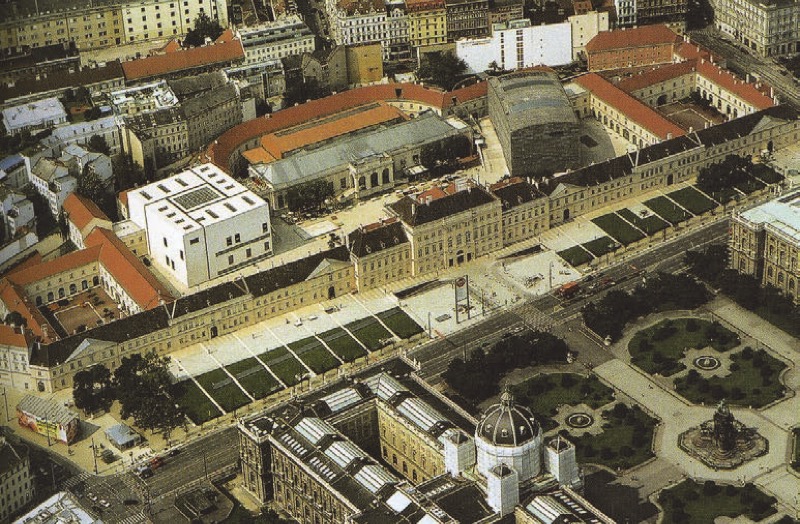
Most of the museums areas mentioned above share a few qualities: custody of noteworthy collections linked to urban scenes of great historical and symbolic value, in which there has been a confluence between programs of architectural restoration and museum renovation which follow at the same time museological factors and media aspirations to attract tourists and visitors. These uses and aspirations stratifications converge in the so-called cultural districts, object of our research, which have become in recent decades one of the most important structural elements in revitalization processes of urban areas, according to Luciana Lazzeretti:
Places cataloged with HC distinction ("high cultural level") are those artistic and cultural sites, in which a set of economic, non-economic and institutional actors decide to use some of the shared idiosyncratic resources (artistic, cultural, social, environment) in order to develop a common project, which is both an economic and a life project5.
Thus, cultural districts clearly define a multi-purpose area in the city, where a high concentration of cultural services serves as lure to develop multiple activities. From this point of view, it is evident the role of these cultural districts
as key elements in shaping not only the image of the city, but also of the urban space renewal. This process is also conditioning the citizens´ appreciation of urban spaces, who have appropriated symbolically the city through the urban imaginary. The potential of these cultural "cluster" not only contributes to heritage conservation policies but also become generators of resources and economic growth, promoting as well culture and knowledge development.
2. The Paseo del Prado as urban landscape and historic cultural district.
The Paseo del Prado has a high concentration of museums and cultural institutions that forms a linear museum district of diachronic character that diversifies its functions in their cross-section areas (las Letras, Jerónimos, Retiro Park, Lavapiés neighborhoods). The axis of the Prado, which is more than the boulevard that named it, shows a paradigmatic historic urban landscape, gathering plans for urban rehabilitation, restoration of historical buildings, new architectures, changes and continuities in urban iconography, functional zoning, and some representative settings of economic and political interests linked to culture. The concentration of great national museums with high level collections is completed with prestigious private art institutions, arts centers devoted to temporary exhibitions, monuments, parks and gardens.
The Prado Boulevard can be catalogued as a cultural district that gathers commercial, administrative or residential functions in its surroundings. The users are both tourists and local population. In this sense, urban collective memory is influenced by the existence of such cultural marks.
As space of representation and symbol of culture, it is obvious the functional, historical and symbolic importance of this Madrid´s area. Its development began when king Felipe IV built Buen Retiro Palace in the vicinity of San Jeronimo Monastery, encouraging the transformation of this eastern area, which became a promenade planted with trees for the Court entertainment in the seventeenth and in the eighteenth centuries (fig. 2)
Cultural and aesthetical urban operations would be stratified along the eighteenth and nineteenth centuries. In the reign of Charles III (1716-1788), by the impulse of the chairman of Castile at the time, Count of Aranda, took place the first major urban redevelopment in the valley that ran from north to south of the city, where the presence of orchards and urban voids was dominant. The works began in 1763 according to the design proposed by engineer
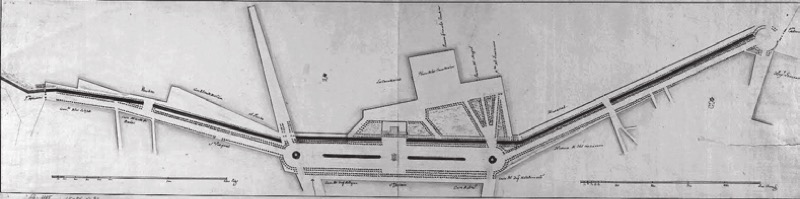
and architect José de Hermosilla, who based his plan on the channeling of the la Castellana stream, that flowed between the two wall´s gates (Recoletos and Atocha) placed at the both ends of the walk, with the purpose to generate a series of consecutive walks named from this origin "meadows" (prados), all of them embellished as walks with gardens and tree-lined avenues.
The principal, the "Salon del Prado", whose layout is recognized in the known plan from the original Hermosilla´s drawing of 1767 (fig. 3), stood out for their conception, as the architect designed a circus space of Roman reminiscences articulated by monumental fountains (Cibeles, Apollo and Neptune) designed by the architect Ventura Rodriguez (fig. 4) and carved by the most important sculptors of that moment6.
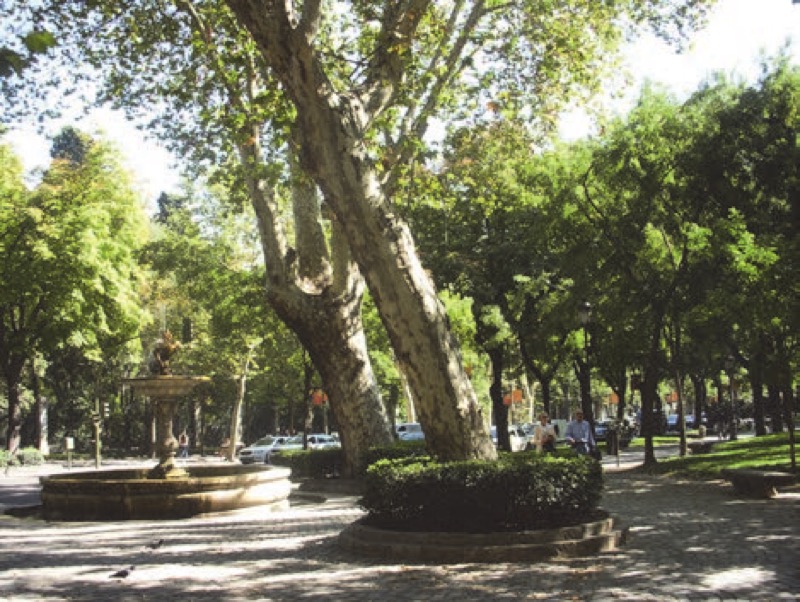

The word "Salon" ("living") externalizes a domestic ambience with connotations of social meeting, and it was provided with a high landscape and ornamental features, achieved through an overall scenographic and symbolic design. But also, it would take place a first concentration of cultural facilities for culture linked to urban renewal operations of Paseo del Prado: the "Hill of Sciences" project designed by the architect Juan de Villanueva following the formula in vogue of a cultural and scientific Acropolis. The construction of a Cabinet and an Academy of Natural History7, a Botanical Garden and an Astronomical Observatory, together with the construction of the first Madrid´s General Hospital on Atocha roundabout, designed by José de Hermosilla in 1756 and completed by Francisco Sabatini8. The Prado Boulevard was the
place of the classicist and pro-European imaginary, where the mythology, the Enlightenment culture and the nature were harmonically joined. All in all, it was a monumental operation with representative and renovation purposes that would mark the future of this urban area.
Later, during the nineteenth and early twentieth centuries, related to the extension and the construction of the modern bourgeois city, the Prado was completed with aristocratic palaces and official buildings like the Stock Exchange building, the Bank of Spain, Villahermosa Palace (at present home of the Museum Thyssen-Bornemisza), the National Congress, Atocha Station, the Royal Spanish Academy of Language, the Ministry of Development, Ritz and Palace Hotel, among others. The transformation of the Prado Boulevard along the twentieth century began to diverge from its original sense of a landscaped walkway to become a powerful north-south axis of city traffic (figs. 5-6).


However, the Prado Boulevard is identified with one of the most emblematic touristic and cultural areas of Europe, place of major museums and historical monuments. Its history has been marked by the promotion of a culture policy based on prestigious architectural interventions. Moreover, a progressive number of museums with an international presence located in this area since the mid-80s of last century has determined it as the "Paseo de las Artes", due to the presence of the following institutions on that area: Prado National Museum (Figure 7), Reina Sofía National Museum, Thyssen Bornemisza Foundation

Museum, Ethnology and Anthropology National Museum, National Museum of Decorative Arts, Naval Museum. In the recent decades, have been added new cultural and exhibition centers to the Prado axis and its surroundings, mostly placed in restored historical buildings: Center-Center (in the Telecommunications Palace rehabilitated as new headquarters of the City of Madrid), Caixa Forum, la Casa Encendida, the ancient Tobacco Factory, MAPFRE Foundation exhibition hall, the House of America, among others.
The heritage character of the axis itself (BIC)9, the large number of buildings and the cultural and natural elements, catalogued by municipal town-planning, determine that the area has been subjected to ongoing plans and projects with the aim not only to renew museographically museum institutions but also to solve problems related to the weakening of its urban and environmental quality.
2.1. Landscape and urban plans and projects.
At the beginning of the 80s of the past century, Atocha and its adjacent areas had lost their monumentality and significance of the enlightened and nineteenth-century conception, due to its transformation into the main artery for north-south road traffic. Therefore, the implementation of the new cultural project that embodied Reina Sofia National Museum, by rehabilitating the old General Hospital San Carlos (fig. 8), should be associated to an environmental, urban and social regeneration of this southern area throughout a special plan, the Atocha Operation, as part of the project The Key of South, which in turn was included in the general land-use planning of the city of Madrid (1985)10. The architect Antonio Fernández Alba was the responsible for the road circulatory flow rearranging and pedestrianization of some spaces for public use. But Operation Atocha, although it assumed an environmental and aesthetic requalification of the Atocha roundabout zone, did not solve the global problems caused by the pressure of vehicular traffic on the Prado axis, a traditional urban landscape strongly characterized by the presence of parks, gardens and green spaces around.

To attend this point, in the year 2000 the Madrid City Council carried out the announcement of an international restricted competition whose aim would be the development of a Recoletos-Prado axis Special Plan: the winning plan was the one lead by Portuguese architect Alvaro Siza Vieira11. This Plan was firstly approved in 2005, but in the subsequent years experienced a process of constant review and modifications by several allegations and suggestions received both by regional public administration and other organizations and individuals as well, which has led to the its slowdown and stoppage12.
The perimeter of Plan finally was constrained to the Paseo between Cibeles and Atocha, as it is in this area where it would be introduced a new urban development involving the set of elements that constitute the Prado heritage protection area (BIC), recovering the Salon del Prado historical organization. In addition, some museums experienced a renewal of their environments under the Plan guidelines. But overall, the Recoletos-Prado Special Plan aimed to achieve a response to the following premises: the environmental problems caused by the damaging effects resulting from the high concentration of traffic in the area, the problems of accessibility and connectivity between cultural institutions and museums, and finally the need to protect the environment, landscape and heritage values of the Prado and its historical surroundings (Fig. 9 a-b).
To achieve a more livable and sustainable city was necessary the reduction of the traffic lanes in the promenade and the increase both of pedestrian walkway areas and wooded areas and gardens13. However, a problem would arise due to the conflict of interests between the pursuit of a public, social and aesthetic city space and the pragmatic function posed by the axis as the main communication artery between city´s southern and northern.


2.2. Memory and historic identity.
The urban planner and theorist Kevin Lynch places in his famous work The Image of the City (1960) a priority on the meaning of reading the city as part of the collective memory. This quality would be embodied in certain buildings as landmarks that establish a semantic relationship while serving as orientation and spatial location.
In fact, the identity and the historical dimension of the urban landscape are growing interest from the last third of the twentieth century onwards, when the concept of cultural landscape emerges and is applied not only to territorial or rural settings but also to the urban areas (Maderuelo & Rivera, 2011: 133-139). This recognition has led to the setting up of policies supported by the European Landscape Convention (Florence, 2000), coming into force in Spain in 2008. The Quality Plan of Urban Landscape of the city of Madrid14 reveals many of the concerns contained in partial and special plans that have affected previously Prado area, and specifically considers the growing touristic activity related to the presence of museums and their relationship with the urban image. The document refers to the need for implementing the following aspects: to restore the landscape and architectural values of the city and to define and characterize the unique elements that distinguish it from a perspective of sustainable development, through several objectives, including the articulation of various traditional components with the creation of images and innovative references. It is also worthy of mention the need for identifying and facilitating touristic tours to promote awareness regarding the monuments and encouraging artistic performances in the city itself15.
Concerning, our case study, the last action that reflects the constant institutional will for the requalification of the Paseo del Prado was the presentation, in March 2014, by local government, of the "Site of Retiro and the Prado" to be considered for inclusion in the UNESCO World Heritage List16, arguing its
"outstanding universal value", supported largely by its recognition as a representative asset value of a type of evolutionary urban landscape that illustrates several significant periods in the history of the capital, and so the museum wealth of international presence. This statement would also be the endorsement of the international presence of Madrid as a touristic and cultural city, re-launching its image and reinforcing collective memory.
The perimeter of the main core delimitation and of transition zones, as shown on the plan (fig. 10), would include in addition to important monuments and historical neighborhoods like Jeronimos or the Barrio de las Letras, spaces with relation to the main museums like the Prado National Museum, with its extensions in the Cason del Buen Retiro and the Royal Hall; Museum of Anthropology, the Reina Sofia National Museum and the Thyssen-Bornemisza Museum, all of them as historical museum heritage linked to the cultural tradition of the Prado Boulevard.

The influence of the Prado axis in areas of cross contact has caused some phenomena of gentrification in borderline neighborhoods such as Barrio de las Letras (the writters´ neighborhood), and, to a lesser extent, in Lavapies. The called El Barrio de las Letras, is closely linked to the development of the Prado axis, as a "natural" extension dedicated to tourist and local population services like hotels, bars and restaurants, and complementary cultural activities, mixing the usual functions of the city with leisure activities for tourists. The engine for renovation has been linked in this case to the the neighborhood of letters cultural project focused on a thematic renovation of this area where some of the main Spanish writers of seventeenth century Golden Age lived (Lope de Vega, Quevedo, Calderon de la Barca).
2.3. Contributions of museums and cultural centers to qualify the urban fabric.
Related to architectural discipline, combined with the desire for social projection of museums have determined the recurrent presence of an urban dimension in the architectural project, developing both external and internal public and collective spaces. In all, museums become permeable architectural objects, inter-acting with their physical, functional and ideological boundaries (Layuno, 2003 & 2013).
Prado National Museum Extension (1998 Competition/ 2002-2007)17, rises on the former site and includes the Jeronimo´s cloister and the area between the back of the Villanueva´s ancient Museum and Ruiz de Alarcón Street. The difference in elevation between them allowed the creation of underground passageways to connect them in order to respect the historical environment. On the lower level, the new entry gives access to the main foyer, likely a street that runs longitudinally, a generous space cut into the slope that contains sales ticket, checkrooms, restrooms, information, as well as a café-restaurant, bookshop and museum store. At the top-level, the Ruiz de Alarcon Street facade of the new Moneo´s building displays their contextual and respectful character with the surrounding buildings. On this level, the connection between the new and old buildings is hidden by a planted platform of box
hedges which evokes 18th-century gardens and creates a landscaped area. This one joins up with the Botanical Gardens located next to the Museum, enriching the surrounding landscape and enhancing the architectural perception of the old museum rear facade (figs. 11 a-b-c).

 https://sancheztaffurarquitecto.wordpress.com/2009/01/05/ampliacion-del-museo-del-prado-rafael-moneo-pa-chile/)" loading="lazy" style="max-width:100%;height:auto;">

This contextual dimension is strengthened when the project is understood as a "museum campus", where functional programming is fragmented into several nearby containers formally connected between them in some cases. This campus is formed by Villanueva building, Moneo´s extension, the administrative building of Ruiz de Alarcon Street (existing), the renovation and restoration of two remaining dependencies of the destroyed Buen Retiro Palace, Cason del Buen Retiro (houses the Prado School and previously housed collections of nineteenth-century of the museum), and the Hall of Realms. This last, will be the object of a new Prado Museum Extension, through a new international competition.
As for the National Museum Reina Sofía, it combines two different heritage intervention typologies. On the one hand, the restoration project of the old General Hospital of San Carlos as Arts Centre by architect Antonio Fernández Alba (1980-1986) (Fernández Alba, 1987 a-b), and the subsequent rehabilitation project as National Museum by the studio Iñiguez de Onzoño and Vázquez de Castro (1987-1992)18, embrace an externalization of museum civic functions enabling a square in front of the main building's façade, conceived as a public space open to the city (fig. 12). By the other hand, the Reina Sofia National Museum extension (2001-2005), designed by architect Jean Nouvel, continues promoting this urban quality, now in an introspective level to answer the hostility of the urban surroundings (fig. 13 a-b).


The compositional solution of the project expresses a clear urban metaphor through three different architectural spaces which embrace an interior square covered by a zinc roof. These three different buildings planned to temporary exhibitions, a cafe-restaurant and auditorium, a library and a book-shop respectively offices areas, establish an external relationship with each of the streets that line up, while generate an interior space treated as a hard plaza, which aims unsuccessfully to become a field of collective experiences by keeping almost exclusively a distribution and access functions to the spaces that limit it.
Located in front of the Botanical Garden, alongside the Prado Axis, the CaixaForum cultural center was housed in an old power station built in 1899 and acquired in 2001 by the La Caixa Foundation, an institution created by an important Catalonian bank. The new center (2004-2008), close to the Prado, the Reina Sofia and the Thyssen-Bornemisza museums, was entrusted to the prestigious Swiss architects Herzog & de Meuron (Márquez & Levene, 2006: 336-347). Through the removal of the former old building granite basement, the architects could lifted the building off the ground, to design a large public plaza under it, opened to all four sides, extending the Prado touristic walkways. The possibility of the former gas station demolition was crucial to open and connect the space between the Prado Boulevard and the neighborhood of the Golden Age writers across the plaza, creating an aesthetical urban segment. This sheltered space under the CaixaForum functions as a meeting point to visitors, besides being a pedestrian walk between the Paseo del Prado and the adjacent streets (figs. 14 a-b).


Another cultural institution, Medialab Prado, next to the CaixaForum receives the synergy of the Prado axis by presenting itself as an alternative model to the official culture of the Boulevard of the Arts. This center was promoted by the city council as a laboratory for research, promotion and dissemination of cultural projects exploring forms of collaborative learning, through the experimentation of emerging digital networks and dissemination of art and digital culture. Medialab occupies an old concrete industrial building, the Belgian Sawmill, built in various stages from the 1920´s onwards, whose adaptation project (2007-2008) was carried out by Spanish studio Langarita-Navarro. The project generated an external public space, la plaza de las letras, which connects with the Caixa Forum plaza, contributing therefore to the swelling of the historical plot (Alonso & Acebo, 2013). Medialab´s plaza is conceived as an open-air auditorium which backdrop, the front of the building, is conceived as a digital facade (urban media-facade), to project artistic and social creations developed by research groups attached to Medialab (fig. 15).

It could be conclude that there is a gap between projects´ intention and real use of each museum, as shows the graphical representation of each competition project. This distance between space design and use of space determines that the cliché used in each project as a catalyst for urban public space, mostly would act as an aesthetic gesture of the execution process and functional use of it, more than a real achievement. The ideal post-modern museology space not always constitutes a collective social place in the sense of aspirations of Henri Lefebvre on urban space as a product of social relations and playful appropriation by citizens (Lefèbvre, 2013).
Without denying their status as public spaces, and the obvious compatibility between the aesthetic and the public aspects, an important issue to consider in relation to this argument is the role played by the museum or cultural center in the context of the current crisis of public space. Under the circumstances that hinder these tasks taking part in urban life, many have claimed the museum could replace the role of public space generator -for meeting, sharing, celebration and memory-, which has played the city historically (Martí, 2007: 88-90).
The presence of this type of public space in the Prado Boulevard of Arts diverge from one situation to another. Most of the mentioned museum projects had hardly become public spaces for the local community. It may be emphasized that some of these spaces are often empty because are conceived as landmarks of a powerful qualification of the urban fabric, rather than places to meet and stay as platforms for tourist pedestrian walk between distant points of the Boulevard.
In addition, the diverse urban and architectural interventions share a hostile context due to the presence of excessive traffic and acoustic pollution.
In contrast, to the hedonistic green carpet that unfolds in front of the facade of Moneo´s Prado Museum´s extension, or the broken geometry of the shady plaza of CaixaForum Center, the square facing Reina Sofia National Museum, despite not having reached the initial program goals of becoming a museum extension to cultural activities, it is interesting because of the public functions it has acquired over the time: as a place of recreation for the youth and children of the neighborhood, and as a place for political party meetings (fig. 16).

3. Conclusions.
The multidirectional relationship of museums and cities allows at least two reflections. Firstly, there is evidence that museums contribute to generate urban morphology an iconography, all despite the problems they would generate by dialoguing with the city and pre-existing urban fabric. From the morphological point of view, the Prado Boulevard is currently a sum of fragments from diffe-rent museums, cultural buildings, monuments and parks. Although has not lost its identity yet, it is continually threatened by traffic and acoustic pollution.
Secondly, we have already stated that all projects are placed at the crossroads of their aspirations as sites of coexistence as social landscapes and/or as aesthetic segments of the city. At this point lies one of the problems arose from the condition of the museum as urban monument in todayʹs society, based on the dilemma between social and aesthetical implications, not antithetical terms as we have already mentioned. The terms public space and aesth-
etic space have been emphasized throughout this article as two main concepts already applied or in progress in the Prado Boulevard urban interventions. In fact, projects mentioned above have influenced urban regeneration opening new spaces in the thick urban fabric, and have made great contributions with architectural and environmental qualified values. Besides, they have provided public spaces inspired by their condition of high quality architectural pieces placed in the Prado Boulevard of Arts, responding to the situation of being a cultural and a tourist focus. In doing so, museums are contributing in turn to the construction of a cultural ima-ginary of the city of Madrid.
It must be considered that many of the actions carried out in the urban environment of museums, encouraged by new construction or an extension of the pre-existent building, perpetuate the historical condition of museums as a sacred monument or shrine, surrounded by an auratic environment of high aesth-etic va-lue, isolated from daily life activities. But nevertheless, it is well known the weak-nesses of the Prado axis in their condition of collective public space. The use of public space by community is much lesser than the use of it by tourists, except in the adjacent neighborhoods and in some spaces generated by museums such as the Reina Sofia National Museum. We find very interesting to see how it occurs throughout the spaces generated by the museums on the Prado Boulevard, which shows the conflict between the sublime formalization of these spaces and the appropriation of it by tourists and local population, besides the influence of other city functions.
To conclude, plans and projects for the Prado Boulevard have been targeted, with evident success but still with gaps to fulfill to encourage a process of establishment and dynamic urban renewal, as well as an improve of social, economic and cultural life in the city. However, this process of progressive conversion of Prado Boulevard into a cultural district should be carried out without destruction of memory and identity, avoiding to expel the local population in the context of strong process of gentrification which is currently observed in other museums districts.