The Aesthetics and Symbolism of Antoni Gaudí's Palau Güell
CARLES RIUS SANTAMARÍA
University of Barcelona
https://orcid.org/0000-0003-4802-248X
carlesrius@ub.edu
Abstract
This paper deals with disclosing the symbolic meaning of Palau Güell. To do this, we will first analyse the different lines and forms present in the building, identifying a main module. Secondly, we will locate the central place where this module is present, showing how the rest of shapes relate to it forming a harmonic unity. Thirdly, we will recognize the kind of geometry that is at the base of this eurythmic beauty and that contributes to having a particular aesthetic experience. Fourthly, the knowledge of this geometry will allow us to decipher the symbolic meaning of this work, which aims at giving more strength to the ideas of Catalan Renaixença, both in its political and religious dimensions. Finally, I will show how Palau Güell is linked to other works located in the city, and also outside it, where a similar type of geometry is present.
Keywords
Palau Güell, forms, geometry, symbolism.
Resumen
Este artículo trata de dar a conocer el significado simbólico del Palau Güell. Para ello, en primer lugar, analizaremos las diferentes líneas y formas presentes en el edificio, identificando un módulo principal. En segundo lugar, ubicaremos la zona central donde está presente este módulo, mostrando cómo el resto de formas se relacionan con él formando una unidad armónica. En tercer lugar, reconoceremos el tipo de geometría que está en la base de esta belleza eurítmica y que contribuye a tener una experiencia estética particular. En cuarto lugar, el conocimiento de esta geometría nos permitirá descifrar el significado simbólico de esta obra, que pretende dar más fuerza a las ideas de la Renaixença catalana, tanto en su dimensión política como religiosa. Finalmente, mostraré cómo el Palau Güell se vincula con otras obras situadas en la ciudad, y también fuera de ella, donde está presente un tipo de geometría similar.
Palabras clave
Palau Güell, formas, geometría, simbolismo.
In December 1883, Eusebi Güell and his family had to leave the house where they lived in Barcelona, Palau Fonollar, and went to his father's old house, which was located in the Rambla dels Caputxins, 35-37. From then on, they started thinking about building a new nest. With this intention, in 1884 they bought several buildings located very close to the paternal house, in the old Conde de Asalto Street (today Carrer Nou de la Rambla). In 1885, Eusebi Güell commissioned the project of the new house from the architect Antoni Gaudí, who since 1884 had already been building the entrance pavilions for the estate that the family had on the outskirts of the city, which today are known as the Güell Pavilions. The construction of the new palace began in the winter of 1886.
And although the date 1888 is written on the facade as the year of completion, we know that in 1891 decoration work was still being done.
The Güell-López family and their ten children dwelled in Palau Güell and in the Rambles house for about fifteen years. In 1907, the family moved to live in Park Güell, the other major project in which Eusebi Güell and Antoni Gaudí had been involved since 1900. It was there that on 8 July 1918 the Count Güell died. But the next day, his corpse was dressed in the white habit of the Order of Mercy or the Mercedarians1, the coffin was moved to Palau Güell, and placed in the middle of the central hall, where the funeral chapel was installed.
Since the Count's death, Palau Güell has seen many vicissitudes, until today when it has become one of Gaudí's most studied works and a top tourist attraction. However, in my opinion, what gives unity and strength to this work is yet to be discovered: its symbolic meaning. This essay aims to reveal this significance. But to do that, we will start by studying in it the following key aesthetic ideas: lines, forms, movements, harmony, and light.
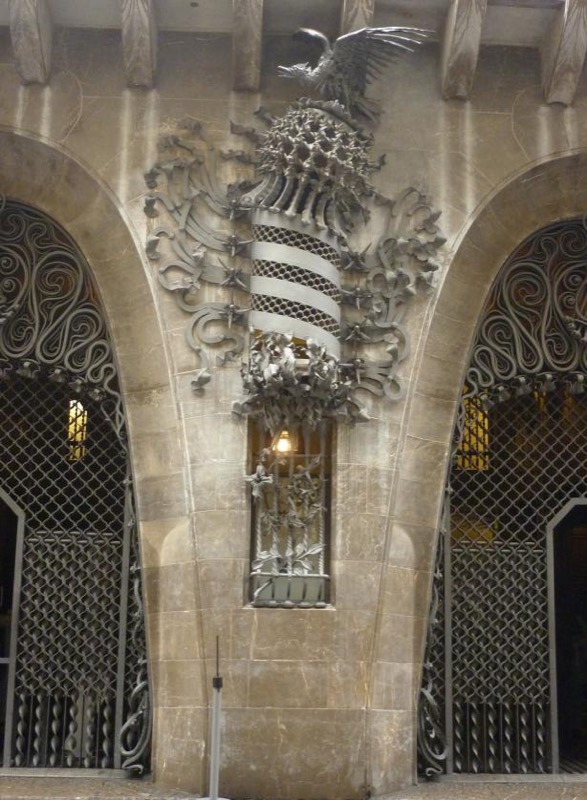
Looking at Palau Güell from the outside, one can identify a series of elements that point to a vertical direction, of which I would like to highlight the following ones. First of all, the two entrance portals have a shape close to that of a catenary arch, and a wrought iron gate consisting of snakes with a defiant attitude, vertical bars with helical shapes, and in the transom, serpentine lines that converge in two initials, the "E" of Eusebi, and the "G" of Güell. Secondly, between these two portals, there is a set also made of iron and composed of a Catalan flag curled up forming a helicoid, a helmet, and above it a bird taking off that represents the Phoenix that rises from the ashes. And thirdly, located in a straight line with this set, on the cornice of the building there is the aforementioned date 1888, and above a green ceramic chimney, which is the highest and largest one of the four in the facade.
All these elements indicate that inside the house there is a very well protected secret: something related to a vertical axis located in the centre of the building; axis that points to an upward movement in a helical shape that emerges from underground and culminates at the top of the building. Here this movement is linked to the idea of a renaissance of Catalan culture, symbolized by the flag, the helmet and the Phoenix bird: a rebirth that has reminiscences of the claiming social movement known as the Catalan Renaixença, which also had a religious dimension that we will probably find more developed inside the building.
When you enter the palace, the first thing you find is the vestibule with two passages for the carriages, each corresponding to one portal, and in the middle a platform from which the staircase of honour starts. Focusing on the formal aspect, at this level there are several elements that are worth highlighting. Thus, there are six long columns, with a one-piece cylindrical shaft and an octagonal and pyramidal capital that recalls the monumental art of ancient Egypt2. The ceilings above the passages have bricks forming large squares with other concentric squares, or with a Greek cross and diagonals inside. And the ceiling of the centre platform contains a decorative motif made of marble consisting of a half-orange vault with a hole in the middle, but inverted, that is, placed downwards and as if seen from the outside.
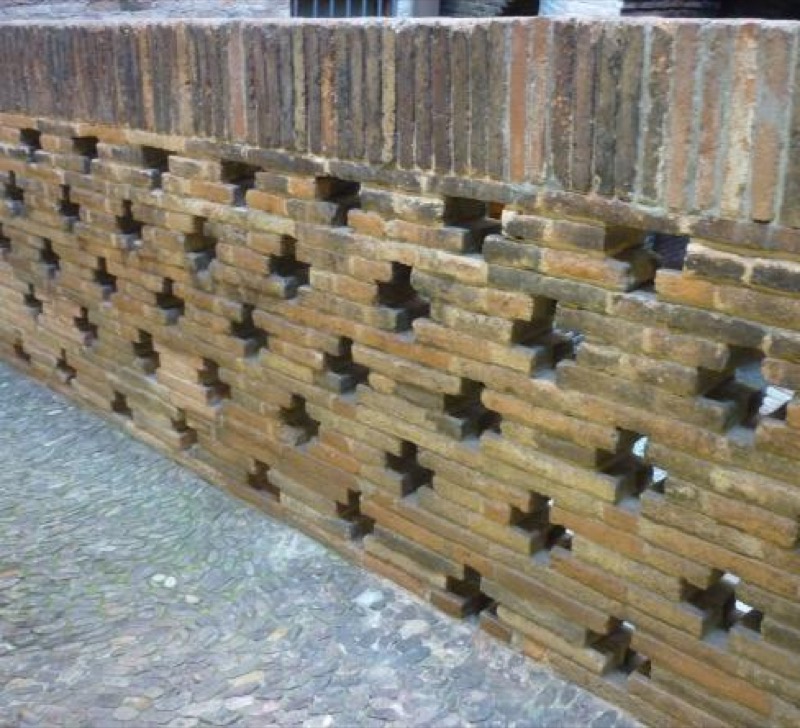
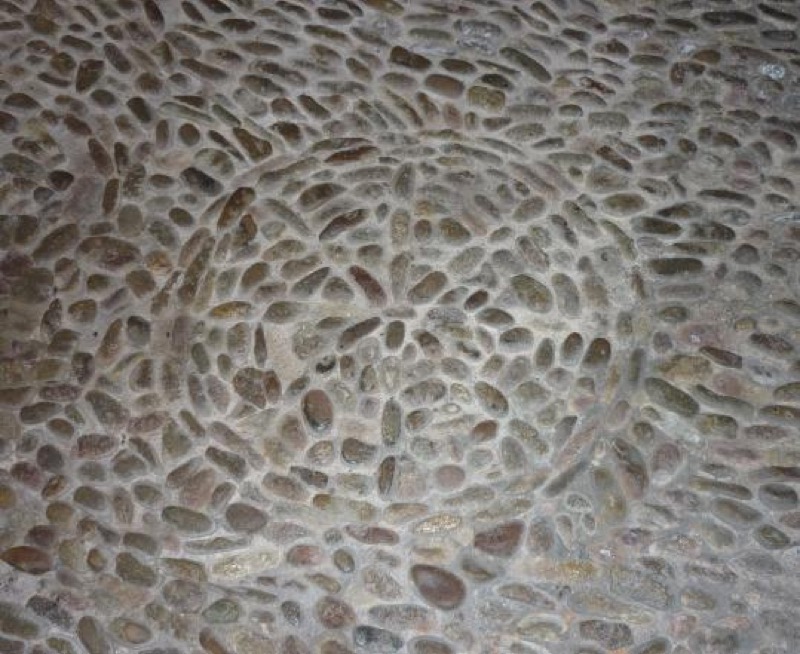
At the end of each passage, there is a large wooden door that leads to the coach house. From this, two ramps lead to the basement, where the stable was. One ramp is located right in the centre of the building and has the shape of a spiral that we have already seen alluded to in the helical axis of the building's facade. And the other slope, located at the bottom, consists of three corridors that turn at right angle, and have a floor of pebbles arranged to form wavy motions. In the longest corridor, we find a railing made of bricks and which has holes in the shape of a Greek cross. And among the pebbles on the ground that form seemingly contingent undulations, you can identify a geometric figure consisting of a circle with a Greek cross and diagonals inside it:
On reaching the basement, one finds large pillars made of brick circles, which have a cylindrical shaft and a huge capital in the shape of a truncated cone. The shapes of these pillars also refer to the upward helical movement, now centralized on the ramp.
To go up to the main floor, you have to go back to the ground floor and go up the staircase of honour. At the end of this staircase, there is an illuminated stained-glass window where the vertical irons with wavy shapes present at the entrance door are repeated, but here configuring a coat of arms of Catalonia, and also with rosebuds that, in addition to recalling the predominant vertical movement, allude to the prize that one of the great writers of the Catalan Renaixença, Jacint Verdaguer, had won with the poem L'Atlàntida3.
This stained-glass window is located at the level of a mezzanine, so that to the right and left there are wooden doors with embossed iron panels that here again form squares with Greek crosses and diagonals but with more filigrees.
The door on the left leads into a large and sumptuous hall, all lined with marbles of different colours. On the ceiling, the curious motif of the small half-orange vaults with a hole in the centre appears again.
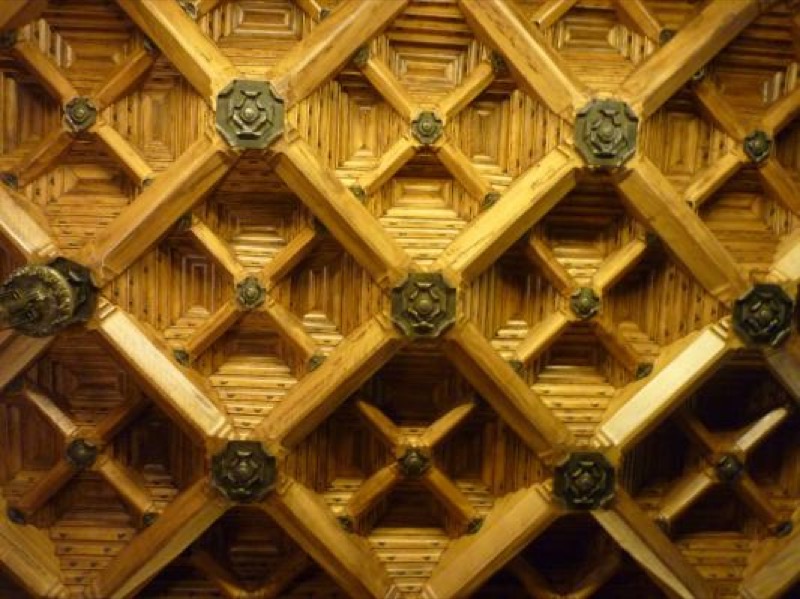
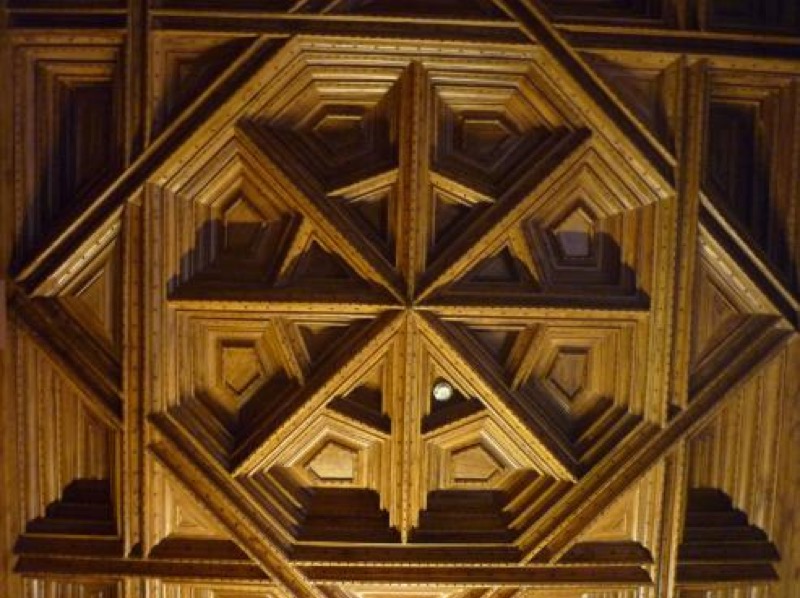
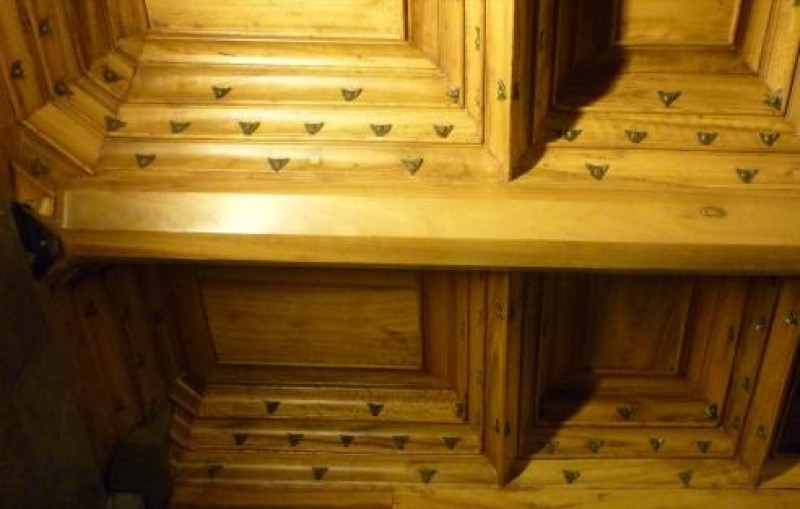
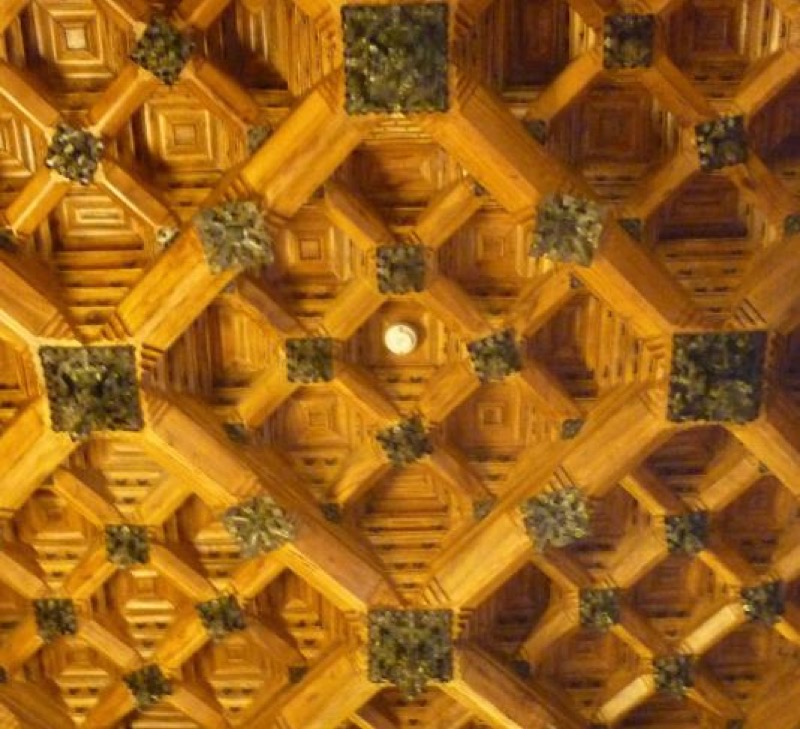
At the end of the hall there is a second flight of stairs that leads to the main floor, where one of the most relevant aspects from a formal viewpoint are the ceilings. Thus, when going up the stairs, one can already perceive a wooden coffered ceiling with beams that form squares with Greek crosses and diagonals in their interiors. Once reached the first floor, one finds a similar motif but with a rich range of variations, in the rooms that make up the entire northwest wing: the antechamber, the hall of lost steps, and the visitors' room. In addition, on some of these ceilings we find small and mysterious pieces of iron with a triangular shape that are located in a zigzag pattern.
As for the southeast wing of the main floor, this is made up of the so-called hall of intimates, the smoking room and the dining room. In some places in this part you can also identify the aforementioned geometric shapes (concentric squares, crosses and diagonals), to which two more are added: six-pointed stars and five-pointed stars.
However, all these rooms of the main floor with this decorative richness are located around a space that is undoubtedly the most important of this floor: the central hall. The main entrance to this space is in the hall of lost steps, flanked by two double lamps of iron and brass, which at the bottom are the form of a Greek cross, rise with a vertical arm with curled lines in a helical shape, and end with a glass globe frame.
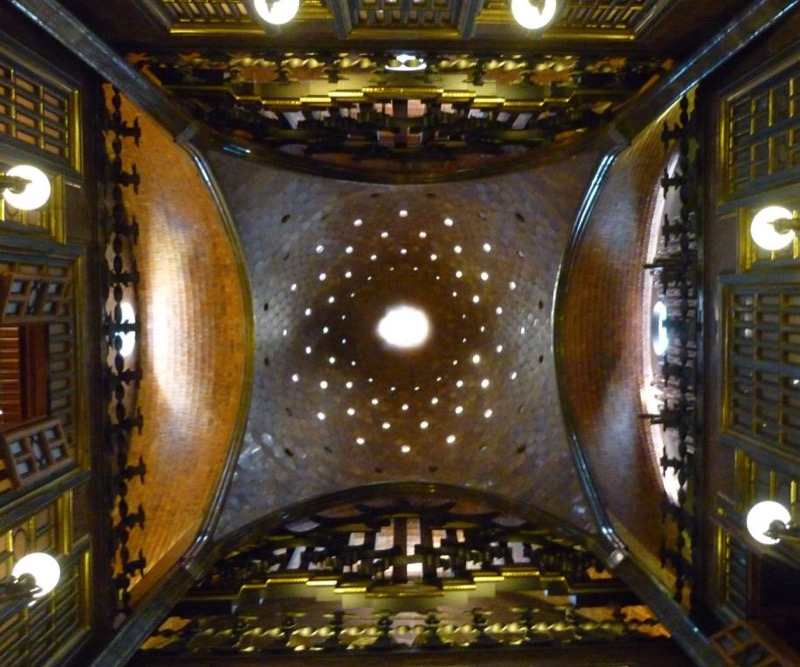
Another indicator that one is about to enter a special space is the entrance door, which is made of panels covered with fragmented shell in the manner of trencadís, and held with brass studs that frame six panels painted by Aleix Clapés where, for the first time, one can capture the expression emerging from the form. When you open the door and enter, you find yourself in a rather dark place, with a surface that is not very large but of great height, a height that includes the main floor, the bedroom floor and the attic. And when you stand in the centre and raise your head, you see above a very beautiful vault formed by five concentric circles of openings, as well as a large central oculus through which natural light enters. The association with the celestial vault is inevitable: an ordered and enigmatic cosmos that produces a profound aesthetic experience.
In Palau Güell, this vault was designed to protect everything that was in this area, as well as the activities that took place there, especially brilliant music concerts helped by the extraordinary acoustics of this space. Thus, once you enter the hall, on the left you will find a staircase that leads to a second mezzanine, open to the hall, where the musicians sat during the concerts. And on the right-hand side there is a closet-chapel, where originally there was an image of the Immaculate Conception, and next to it an organ console designed by Gaudí, whose pipes, however, are located two floors above, right under the vault.
As has been said, this hall is the centre around which all the rooms on the main floor distribute, and one of the most impressive spaces in the entire building. But, as I will show below, it is also important from the formal viewpoint that we are considering here. Thus, in the tour we have taken so far, we have identified three main forms which, with some variations, have appeared at various times:
a) The square, the cross and the diagonals: recognized in the coffered ceilings and in various decorative motifs.
b) The helical shape pointing to an upward movement: found in the set of the flag, the helmet and the Phoenix bird on the facade; in the basement ramp; in the stained-glass window of the first mezzanine; and in decorative elements such as lamps.
c) The vault shape with a hole in the centre: located in the ceilings of the ground floor and the first mezzanine.
Well, we are now in a position to affirm that these forms are also present in the central hall. Thus, we can say that:
a) The square, the Greek cross and the diagonals appear like this: the square, within the framework of the surface occupied by the central hall itself (which measures 8 m x 8 m); the cross, in the lines that form the eight lamps that are at the base of the second floor; and the diagonals, in the arches that arise from this second floor (see Fig. 4).
b) The helical form is alluded by: a vertical axis that starts at the spiral ramp in the basement, crosses through the centre of the whole hall, and passes through the oculus of the vault.
c) The form of vault with a hole in the centre is found precisely with the dome and the oculus that covers the hall. Here we note a difference between how this vault appeared in the decorative elements (viewed from outside and downwards), and how it appears in the central hall (from inside and upward).
Therefore, we can affirm that the presence of these three forms up to the main floor, have the function of preparing the visitor to capture them when entering the primordial space that is the central hall.
But if continue with the visit, to go up to the second floor, one has to take a staircase that starts from the mezzanine of the musicians. On this second level, the bedrooms of the whole family were located, rooms that are distributed around an ambulatory with a window gallery overlooking the central hall. Throughout this level, the decoration is much simpler than on the lower floors. However, there are some elements that from a formal viewpoint are worth highlighting. One of them is the hall of intimates, used by the house mistress, Isabel López i Bru. In this space there is a fireplace designed by Camil Oliveras, which has a white marble panel painted by Alexandre de Riquer, where Isabel of Hungary is depicted spinning, in a background with geometric figures similar to those we have seen previously: a square, concentric circles, Greek cross and diagonals.
Next to the bathrooms, there are more modest stairs that lead to the attics. On this level is where the servant's bedrooms were. In this area, we should also highlight the windows that look to the central hall, finished in a parabolic shape, and made of a glass design forming a trencadís of pale tones.
Taking the service stairs, you can access the upper level of the building: the rooftop. In this space, the first thing one perceives is a high spire located in the centre and surrounded by several chimneys with very creative shapes and decorations: twenty in total, six of them made of bricks and located in the south angle, and the other fourteen covered with ceramic tiles and spread over the roof. However, the formal analysis we have made so far allows us to realize that at the base of such a profusion of lines, colours and textures, there are some predominant forms, in the manner of a canon, which are precisely the same as we have found along the entire visit: square, circle, Greek cross, diagonals, eight-pointed star, and hexagram.
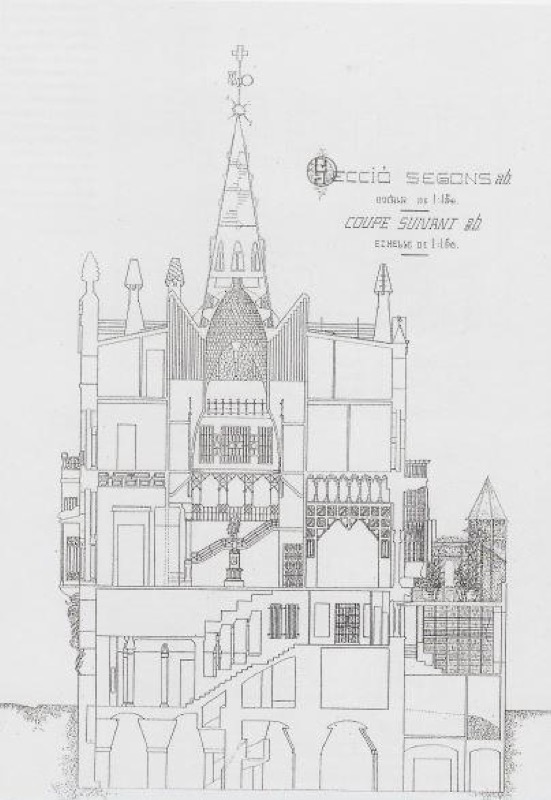
Now, the main element of this level is the spire, for several reasons: because it is the highest component of the roof; because it is crowned by some eye-catching elements; and also because it turns out that this pinnacle is located in the centre of the roof and of the whole building, just above the vault of the central hall, being the highest point of the vertical axis already alluded to in the facade, the one that inside begins with the helical ramp of the basement and continues through the middle of the central hall, the vault and the oculus. This can be seen in the following image:
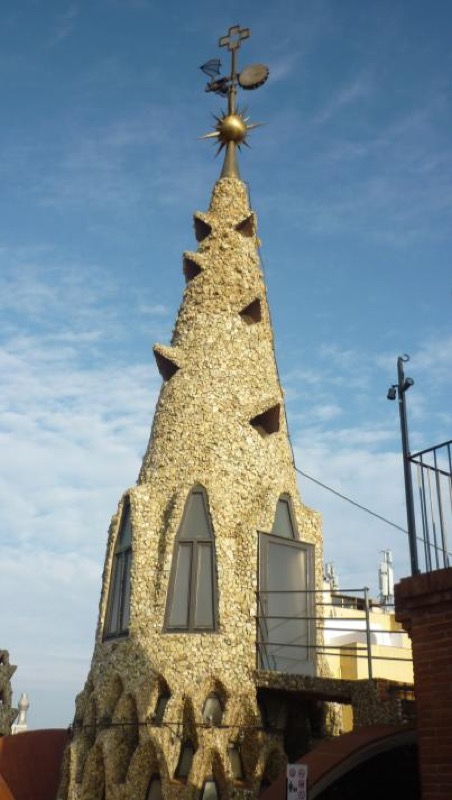
Analysing this pinnacle in more detail, one can see that it has a cone shape, 15 m high, and a circular base with a diameter measuring 4 m. In the lower part there are four superimposed coaxial rings, each one composed of sixteen windows with a parabolic shape. In truth, through these windows enters the natural light that illuminates four of the five circles of openings around the central hall. Above these rings there is another circle formed by eight larger windows also finished in a parabolic shape, one of which is a door that can only be accessed by means of a walkway. Above these windows, the cone gets narrower, and in this part, there are visors that cover rhomboidal windows grouped in pairs by level, up to the top, where there are four forming a Greek cross.
The pinnacle is covered with glazed stone, and crowning it are two more components: a golden sphere, from which sixteen cones emerge; and the wind vane, with a bat and a tambourine placed horizontally, as well as a Greek cross placed vertically that has an empty central square.
The fact that the spire can be visited on the inside, and that it can only be accessed by means of a fragile walkway suspended in the air, makes it even more interesting. What one finds when entering this area is the following: a luminous and circular room, 3 m in diameter, and a hole in the middle with a diameter of 45 cm; the eight windows; and above, where the cone narrows, a series of wooden slats embedded in the walls forming a helix. Looking into the hole, one can see, below, the dark central hall with the spheres of the eight lamps on the second floor outlining the ends of the Greek cross shape; this contrasting with the abundance of light of this conical room: in fact, the brightest in the whole building.
After experiencing all this, one can recapitulate everything seen, and summarize it as follows. In all the variety of lines, shapes and figures that exist in this work, there are some that predominate, located like this:
a) The square, the Greek cross and the diagonals, shapes that in the central hall appear in this way: the square in the perimeter of the hall; the cross in the position of the eight lamps; the diagonals in the arches and panels of the vault; and all three figures in the vault, starting from the location of the holes.
b) The helical shape pointing to an upward movement, which starts in the basement and then crosses through the middle of the central hall.
c) In this hall, the helical shape taking a centripetal movement, which is suggested by the distribution of the openings, and which centers on the luminous oculus.
d) And once this helical shape has passed through the oculus, it continues upwards but converted into a centrifugal movement that is expressed in: the view that is contemplated through the windows of the spire; the wooden slats forming the spiral inside; and the golden sphere with cones pointing in all directions.
Having reached this point, one can ask the following questions: what is it that produces the helical movement? And what makes this movement go from centripetal to centrifugal? The thing that seems to produce the helix is the main geometric shapes that manifest in various places of the building. But in the central hall, these forms end up appearing in the vault, which is precisely the place where the spiral goes from centripetal to centrifugal. Then, to try to better answer these questions, we will study more carefully the characteristics of this vault.
As I said above, one of the characteristics of the vault of the central hall is its beauty, linked to the harmony of the elements that compose it. The idea of beauty understood as harmony has a long history in Western culture, and in plastic arts it is usually expressed using geometry (Eco, 2004: pp. 61-97).
In the visit we have made to Palau Güell, we have found a series of regular geometric shapes (the square, the circle, the Greek cross, the hexagram, the pentagram, and the diagonals) that appear in various ways in many decorative motifs. To begin with, we can already locate some of these shapes in the central hall's dome. Thus, this vault is framed in a square and contains five concentric circles of openings. Each of these circles consists of sixteen equidistant holes, which means that several concentric squares, a Greek cross and diagonals can be formed from them. What's more, this vault is made of tiles that have a hexagonal shape –the only place in the whole palace where there are tiles with this shape– that is, the heart from which several six-pointed stars or hexagrams can be formed. Therefore, of all the figures we have found on the tour of the palace, the only one we have not yet been able to identify in the vault is the regular five-pointed star or pentagram. To find out if this figure is there, what I will do next is to resort to a type of geometry that I have discovered is present in other works by Antoni Gaudí.
In 2006 I presented my doctoral thesis on Casa Bellesguard, in which I linked this construction to the work of a German artist that had been a monk of the Benedictine Beuron Congregation, Peter (or Desiderius) Lenz, and who had researched on a type of geometry that he called "aesthetic geometry". This discipline was intended to be a reconstruction of the language God used to create the universe, from the simplest to the most complex forms. After organizing the main figures of this geometry in what I called a "geometric process", I applied this process to Casa Bellesguard, and later to other works, such as Park Güell and the Güell Pavilions (Rius, 2020 y 2023).
The aforementioned geometric process consists of four sections that I summarize below:
1. A sequence of concentric squares, one placed inversely in relation to the previous one, which represents a movement of contraction.
2. A series of expansive hexagrams, all situated in the same position, which reproduces a movement of expansion.
3. A series of concentric hexagrams, one inverted with respect to the previous one, which represents a second contractive action.
4. And the inference of a series of five-pointed stars one located inversely in relation to the previous one, which follows the relationships of the golden section or the so-called divine proportion, and which means a second expansive movement.4
Well, let's now see how this geometric process is also implicit in the dome of Palau Güell, taking the four dark holes situated in the panels of the vault, as the angles of the square frame inside of which the four sections will be played.
As you can see in this image, the large pentagram is inserted in a circle that matches with the one formed by the smaller circle of luminous holes.
To show that indeed this is the place in the vault where the two five-pointed stars expressing the divine proportion are found, I will add the following arguments. First of all, from the first moment one observes the vault, one gets the feeling that a centripetal movement is taking place in it, a feeling promoted by the arrangement of the holes in the circles. However, if you pay more attention, you will realize that when you reach the smallest circle of holes, the centripetal movement seems to slow down: as if it found a resistance, and something opposed were announced; something that makes this the most beautiful and attractive area of the whole vault. Secondly, there the tiles stop being hexagonal and become rectangular and finished with arrow shapes that point to the periphery. Thirdly, the part of the vault where we have inferred the two pentagrams corresponds exactly to the perimeter of the floor of the spire room, that is, to the place where we have seen that the shapes, indeed, suggest a centrifugal movement. And fourthly, there is a component present in the central hall that confirms to us that this is the correct application. Thus, when describing this space, I explained that the entrance doors to the living room are covered with panels held with small brass studs. These studs have a square form, and, in reality, they appear in two other places: on the doors of the closet-chapel; and inside the chapel itself, fixing the brass plates that cover the walls. All these studs have the same design consisting of a relief with the following shapes: a square, two concentric circles between which there are lines, four points alluding to a Greek cross, and four points alluding to diagonals.
As can be seen in this image, there are sixteen stripes that are arranged radially between the two circles, and they suggest an expansive movement. Moreover, the four points that allude to the diagonals suggest a movement of the same nature. Well, it turns out that the proportions between the two circles in the centre of the stud are the same as those between the oculus and the smaller circle of holes in the vault of the central hall.
Therefore, we can understand that the design of these studs represents the expansive movement that can be seen in the centre of the vault. Or that the artist made this design, once again, to introduce us to the main forms of the entire building, those of the vault.
With this, I think it is clearer that we have managed to find the place in the vault where the five-pointed star or pentagram is present. Now we can answer the questions posed above: what produces the helical motion that emerges from underground and traverses the central hall, and what causes this motion to pass from centripetal to centrifugal, is the geometric process formed in the vault, and the inference there of the golden section or divine proportion. The fact that this geometry is present there is what shapes the visual harmony of this work. In my opinion, this would also explain the extraordinary acoustics of this space.5 So, we can say that although in this dome there is a harmony expressed in the matter that is perceived, this is only a moment of a movement that develops harmoniously in time; that is to say: a good example of an eurythmic aesthetic experience.
Consequently, what is seen in the centre of the vault is only the first indication of a change in orientation in the centripetal helical movement; a change towards a centrifugal movement that will become more perceptible when visiting the roof and the interior of the spire; a change that one will experience more intensely after having inferred the golden section in the centre of the vault. From this moment on the visitor-interpreter will be able to have a series of representations that are part of the aesthetic experience, and that consist of the following elements: the light of the oculus spreads, a luminous spiral rises from below, and once the helicoid has passed through the oculus, the light expands in all directions, as represented in the golden sphere that crowns the pinnacle.
Now, after this aesthetic experience, it is unavoidable to face the following question that, in some way, has been present since the beginning of the visit: What is the meaning of these harmonic forms over time...? This is what we will try answer in the next chapter.
At the beginning of this paper, I have already explained that when one stands in front of the main facade of Palau Güell and sees the set formed by the helical flag, the helmet and the Phoenix bird, one perceives that this set has a political meaning: expressing the Catalan Renaixença. After the tour we have made, we can now specify more precisely the meaning of each part of this set: the flag points to the helicoid; the helmet is also a representation of the vault of the central hall; and the Phoenix that is about to take flight also expresses the centrifugal movement that we have seen manifested on the roof.
However, then I have pointed out that the historical movement of the Renaixença had an important religious dimension, and that we would probably see it develop inside the building, which, indeed, has been the case, given that in the main space of this work, the central hall, in addition to a chapel and an organ, there is a vault with philosophical and religious connotations that we are now beginning to decipher.
But to deal with the religious symbolic meaning of this work, it will be helpful to first review some other aspects of Peter Lenz's aesthetic geometry. Thus, according to him, with the "Fall", the language of Creation was half lost; but the artist can find clues by analysing nature, and also by studying the great civilizations' temples (Egyptian, Jewish, Greek, etc.). There has been a moment in history when this language has been fully expressed again: with the advent of Christianity; so that, according to Peter Lenz, the great dogmas of this religion (the Immaculate Conception, the incarnation and the resurrection) can be explained by means of this geometry. As I have shown in other writings, this is what Peter Lenz and his disciples tried to represent in various artworks. And this is also what Antoni Gaudí did in buildings, such as Casa Bellesguard and Park Güell. Well, now let's see if these ideas about aesthetic geometry allow us to better understand the meaning of what we have discovered so far in Palau Güell.
I have just stated that Peter Lenz understood the Immaculate Conception by means of aesthetic geometry, so that in some of his paintings, on the basis of the artistic forms one can reconstruct the geometric process until inferring the divine proportion, at which point one discovers that the incarnation is being represented there. In a similar way, in other paintings of Lenz where seemingly a Pietà is depicted, one can also reconstruct the geometric process until inferring the divine proportion, when one understands that the resurrection of Jesus Christ is being represented there. This implies that Lenz conceived the relationship between the conception of the Virgin Mary and the resurrection of Jesus Christ, in terms of aesthetic geometry, emphasizing the idea that the resurrection is a kind of rebirth, that is, a renaissance.
Returning now to Palau Güell, in this work we have been able to see that although the geometric shapes that make up the geometric process are already alluded just entering the building, all the lines, shapes and spaces lead to the central hall, and especially to his dome. But having arrived here, one can ask the following question: If in terms of the art that Peter Lenz advocated, the primordial representation was that of the Immaculate Conception understood by means of aesthetic geometry, then how could we explain that in Palau Güell this geometry appears above all on the ceiling of the central hall?
To face this issue, we will analyse in more detail the closet-chapel. Thus, I have explained above that on the walls of this chapel there are brass studs. However, above these walls there is a frieze composed of elements that seem merely decorative, but which in fact are more meaningful than they appear. It consists of a series of dented brass triangles, which have cuts, placed alternately with the point down and up, and leaving a space between them through which you can see the wood underneath forming strips that configure a pattern similar to that of a mountain range. In these wooden strips we see again embedded those small triangular pieces that we have identified in some coffered ceilings of the main floor.
However, the fact that these triangular pieces appear in the chapel, a sacred space, allows us to realize something that also happens in the coffered ceilings but that now becomes more relevant: that the apparent shape of a mountain range can also be understood as a series of letters "M". In addition, when one has been studying the work of Antoni Gaudí for some years, then it is not so difficult to relate these forms to other similar ones, with an identical spelling and also located both in the correct and inverted position, that appear in his other constructions and in which this letter "M" refers to the Virgin Mary; for example, in several places on the serpentine bench of Park Güell.
Consequently, we can affirm that these shapes with the letter "M" that appear both in the closet-chapel and in the coffered ceilings of the Palau Güell are allusions to the Virgin Mary.
However, on the front of the frieze of the closet-chapel, which is where these letters are seen the most, in particular there are three in a row, forming the "MMM" series. Then, can these three "M" have a particular meaning...? If you know the symbolism of Christian art, you will remember that the representation "MMM" often appears meaning "Maria Mater Misericordiae", which means "Mother of God of Mercy". In Catalonia, the Mother of God of Mercy is mainly represented by Our Lady of Mercy (Mare de Déu de la Mercè), which signifies the motherly mercy of the Virgin Mary towards Christian captives who are in danger of losing their faith. It was from this figure that in the 13th century the Order of Our Lady of Mercy or the Mercedarians was formed, which was dedicated to helping those in need, and to which, as above it has been explained, Eusebi Güell felt close6.
Nevertheless, when we talk about the redemptive meaning of the Mother of God of Mercy, it is understood that she acts from heaven, which is where she is after the Assumption took place. This explains that the three "M" of the closet-chapel are located in the frieze and allow us to understand that they also allude to the vault of the central hall, where the Virgin Mary in heaven is represented. This is a thesis reinforced by the fact that in the roof spire, the windows at the base that provide light to the openings in the vault, are grouped in such a way that they also form series of letters "M", in this case forming rings (see Fig. 6).
But having reached this point, we find another difficulty: How can we explain that in the Palau Güell the Virgin Mary appears represented in the form of a parabolic vault with an orifice? Where in this vault could we recognize the Virgin Mary, apart from the indirect allusions with the letter "M"? Well, in my opinion, as follows: What in the vault is represented, is only one part of the Virgin Mary's body, albeit one of the most significant, her womb.
The representation of the Virgin Mary in such a place and in this way could be explained as follows. According to Peter Lenz, and in my opinion also according to Antoni Gaudí, the womb of the Virgin Mary, fruit of the Immaculate Conception and seat of the incarnation, had to be perfect also from the viewpoint of its shape, fulfilling the classical rules of beauty as harmony. In terms of aesthetic geometry, this means that it was a place where the entire geometric process was present until the divine proportion was inferred, at which point the Holy Spirit just appeared. This womb, then, was one of the main conditions of the incarnation and gestation of Jesus Christ, but also of his resurrection, so that then the resurrection can be conceived as a rebirth, a renaissance. The resurrection and ascension of Jesus was an anticipation of the resurrection and Assumption of the Virgin Mary, as well as the resurrection of the dead. Therefore, the representation of the womb of the Virgin Mary in the highest part of the central hall, following the proportions of aesthetic geometry, represents: Virgin Mary in heaven, her womb as a condition of first the rebirth of Jesus, and then the rebirth of human beings7.
With this, we arrive at the analysis of a series of elements that – I warn you now– constitute the most difficult symbols to decipher. So, as I have said, in the closet-chapel there is the frieze where there are large brass triangles that are dented, have cuts, and form the acronym "MMM", which means "Maria Mater Misericordiae". However, if you look carefully at these triangles, you will notice that in each of them the lumps outline a figure: the face of a human being with his mouth and eyes closed. Also, that the cuts look like wounds on the face, bloody and in the shape of crosses. What can these human faces with wounds mean? Well, in my opinion, they represent the Christian martyrs redeemed by Our Lady of Mercy.
From here, we can understand what the helical axis shape that one has to imagine crossing the central hall means: it is a spiral of light that slowly rises up, and that is made up of many faces, expressions that signify the souls of the deceased who are ascending to the matrix that will take them to the new life.
This representation provides a greater meaning to something that here has been mentioned before: the fact that when Eusebi Güell died, his body was dressed in the habit of the Order of Mercy and was deposited in the central hall, in front of the chapel and below the oculus. Presumably it was the place that Eusebi Güell had devised, so that his soul, together with the souls of those who have received the protection of the Virgin of Mercy, would ascend to heaven.
This brings us to the symbolic meaning of the next element: the roof spire. In my opinion, the interior room of this pinnacle, the luminous space where the exit of the oculus ends is the place where one can meet the souls of those who have already ascended to heaven. In truth, we can consider this room as a second chapel: the first, the one in the central hall, was consecrated to the Immaculate Conception; and the second, that of the spire, was dedicated to the Holy Spirit.
So, the twelve rhomboidal windows that go up the pinnacle represent the souls of the twelve apostles: those who appear bodily represented at the doors of the first chapel. Above, the golden sphere with the sixteen cones symbolizes the city at the end of time, the Heavenly Jerusalem, as it is described by Saint John in the Book of Revelation: with the twelve gates always open, and which "does not need the sun or the moon to shine on it, for the Glory of God gives it light, and the Lamb is its lamp"8. Finally, the iron cross that crowns the pinnacle, a Greek cross with a hole in the centre through which the sky is seen, alludes to the return of the Son to the Father and the Spirit that he sends; Spirit that then will descend, illuminating the interior of the spire, the oculus, the vault and the central hall.
To sum up, we can now rearrange the main forms and movements found in the Palau Güell, attributing to them the following symbolic meaning:
a) The square and the Greek cross: the death.
b) The helical and centripetal motion: the renaissance.
c) The centrifugal motion and the diagonals: the eternal life.
These three times are present in both the religious symbolic meaning and the political one; two dimensions that, as has been said, were part of the ideology of the Catalan Renaixença, and which, in fact, were expressed synthetically with the slogan "Faith and Country".
This summary of the symbolic meaning of the work allows us to understand the significance of another form that is implicit in the Palau Güell, and that later Gaudí would manifest explicitly in other works. I mean the Greek cross with the bright diagonals coming out from the centre. Thus, this cross with the diagonals, or, what is similar, the all-white Greek cross, may be considered a synthetic expression of the three times I have just referred to, and represents no longer the cross of death, but the cross of the resurrection or rebirth9.
However, the study of other works by Gaudí has allowed us to know that where this artist placed a white Greek cross, this not only has an eschatological meaning, but also other earthly references where this same symbol appears. Then, one wonders: Does this type of reference also exist in the Palau Güell…? We will dedicate the last part of this paper to solving this question.
At the beginning of this writing, I have explained that when one stands in front of the main facade of the Palau Güell, one easily sees a series of elements that point to a helical axis that will later be found inside the building; and that from the outside, the most eye-catching element of this axis is the green chimney at the top. But after having visited the whole interior of the building, when one goes out on the roof, one realizes that even from there the green chimney is the one that attracts the most attention. Well, if we now draw a straight line that starts from the centre of the roof spire, passes through this green chimney, and goes in the northwest direction, we will see that this line crosses the old Hospital de la Santa Creu (Hospital of the Holy Cross). More specifically, this line ends in a spire that is on the ceiling of the chapel of this hospital complex. This spire is of neoclassical style; but it has the following similarities with the spire of the Palau Güell: its interior measures the same, 3m in diameter; and has eight large windows that configure a regular octagonal base.
In my opinion, these similarities between the spire of the Palau Güell and the spire of the chapel of the old Hospital de la Santa Creu are not accidental, but were promoted by Antoni Gaudí and Eusebi Güell. To support this thesis, I will add the following arguments.
First of all, the old Hospital de la Santa Creu began to be built in 1401, after an agreement between the government of the Barcelona city (the Consell de Cent) and the Chapter of Barcelona Cathedral, and with the support of King Martí l'Humà, who took part in the ceremony to lay the foundation stone. Moreover, we know that Antoni Gaudí particularly appreciated the figure of this king, who had a castle in Bellesguard, on the same land where five hundred years later Gaudí would build one of his important works (Rius, 2011a: pp. 33-34).
Secondly, the chapel of the old Hospital de la Santa Creu was dedicated to the Virgin Mary and Saint Helena, who, according to legend, in 326 found the cross on Mount Calvary where Jesus Christ had been crucified.10 This cross became the emblem of the old Hospital de la Santa Creu, and this emblem has the shape of a Greek cross, the same one that we have found profusely represented in the Palau Güell.
Thirdly, as I have shown in a previous study, in the Güell Pavilions, Gaudí had already arranged some elements, so that also from there a straight line can be drawn that also ends in this spire located on the chapel of the old Hospital de la Santa Creu (Rius, 2023: pp. 240-242).
In short, we have discovered that in the Palau Güell there are some shapes that allude to a line that ends at the chapel of the old Hospital de la Sant Creu. In this way, we can say that the patron and the artist linked the symbols of the Palau Güell to a building that signified the historical origins of this symbolism in Catalonia.
In my opinion, this alignment that we have just discovered is not the only one that occurs in Palau Güell, but there are at least two more. Below I will explain how they can be found and what they mean. Thus, on the roof of the palace, in addition to the green chimney, there is another one that has certain special features: I am referring to a chimney that is located on the northeast facade, which also has a larger cap than the others, and that it is the only one that is covered by with glazed stone, the same material used in the pinnacle. Well, if we now trace another straight line that also starts from the centre of the spire, passes through this other chimney, and heads towards the northeast, we will see that this line crosses several buildings in Barcelona, then it will travel several places in Catalonia, and beyond that it will continue through France and Switzerland, where so far nothing can be seen that could be of interest to us. But once this line has entered southern Germany, it will reach a place that is indeed significant for what we have discovered in this work: the monastery of Beuron, the place where Peter Lenz, the artist who reconstructed the language of aesthetic geometry, lived and worked.
Then, in my view, a second line emerges from the Palau Güell, which is perpendicular to the first one we found, and which connects the roof spire, the glazed stone chimney and the Benedictine monastery of Beuron in Germany.
So, we can now state that with this second line the artist and the patron linked the symbolism of the Palau Güell to a contemporary author who was working on the geometry that is at its base. The fact that this palace was built by means of this geometry, and that, in addition, there is a direct allusion to the Beuron monastery, shows that Antoni Gaudí and Eusebi Güell knew Peter Lenz's aesthetic geometry at least since 1884.
Now, I think that a third alignment starts from the Palau Güell which can be discovered in the following way. If we trace a third line that also leaves the centre of the spire and that is 45º from the first two that we have drawn, we will see that this line goes exactly in north direction. If you follow this line further north, you will notice that it passes exactly through the crossing of the Temple de la Sagrada Família, continues up what is today Gaudí's avenue, and then crosses through the middle of the land in the shape of inverted square that configures the new Hospital de la Santa Creu i Sant Pau:
So, at the end of the visit to the Palau Güell, after studying the forms, the harmony and the symbolism of it, we can conclude that this building is also connected to other buildings made with the same kind of geometry and symbolism, through three alignments: one towards the old Hospital de la Santa Creu, another towards the Benedictine monastery of Beuron, in Germany, and a third towards the Temple de la Sagrada Família, as well as to the new Hospital de la Santa Creu i Sant Pau.
In the case of Palau Güell, these connections emerge as a latticework of lines and Greek crosses similar to those found in the triangular brass pieces in the chapel of the central hall, but now no longer reddish, but white and luminous: like scars healed by a subtle and powerful energy.
In my opinion, there could be more alignments suggested by the artist and the patron of this work... But when one discovers them, then another important question appears: Could it not be that new alignments have been formed since then, relationships that not even the creators themselves glimpsed, and that show the power this works continuous to have more than a century after it was finished...?