Artes Visuales y Globalización: percepciones de profesores de arte y estudiantes de posgrado en una universidad saudí
Resumen
Este estudio explora las percepciones de los profesores y estudiantes de arte sobre la relación entre el arte visual contemporáneo y la globalización, intentando ampliar el camino para la colaboración artística en todo el mundo. Se creó y administró un cuestionario abierto de globalización y artes visuales de veintiún ítems a una muestra de cuarenta y dos participantes, incluidos profesores y estudiantes de posgrado en la Facultad de Diseño y Arte de la Universidad Umm Al-Qura, Arabia Saudita. La encuesta se realizó con el uso de la herramienta 'SurveyMonkey'. Los datos recopilados se dividieron en varios temas mediante el uso de análisis cualitativo deductivo. Este análisis temático aclaró aún más el papel de la globalización en la configuración de las artes visuales y el desarrollo personal de los artistas. También destacó la importancia de promover una sana colaboración artística, albergar galerías de arte internacionales y abordar los desafíos que enfrentan los museos locales para reunir grandes audiencias en ausencia de apoyo externo.
Palabras clave: artes visuales, globalización, arte global, artistas visuales, arte contemporáneo
Abstract
This study explores art faculty and students' perceptions of the relationship between visual contemporary art and globalization, attempting to broaden the path for artistic collaboration throughout the world. A twenty-one-item open-ended visual arts and globalization questionnaire was created and administered on a sample of forty-two participants, including faculty and post-graduate students in the College of Design and Art, Umm Al-Qura University, Saudi Arabia. The survey was conducted with the use of the 'SurveyMonkey' tool. The data collected were divided into various themes through the use of deductive qualitative analysis. This thematic analysis further elucidated globalization's role in shaping visual arts and the personal development of artists. It also highlighted the importance of promoting healthy artistic collaboration, holding international art galleries and addressing the challenges faced by local museums in gathering large audiences in the absence of external support.
Keywords: visual arts, globalization, global art, visual artists, contemporary art
1. Introduction
One can find various studies related to the world economy and globalization, defined here as an increase in number of social interactions that transcend national boundaries, in the contemporary literature (Călinică & Ioan, 2015). Similarly, visual art, referring to that which is appreciated through sight, has itself been deeply transformed as a field due to the effect of globalization (Călinică & Ioan, 2015). This research seeks to identify the multiple ways through which globalization has affected visual art and examine how taking advantage of this phenomenon can contribute to the personal development of artists themselves.
Visual art is inextricably linked to the human experience. It helps us to understand various aspects of our lives, history, culture, and civilization in a way that cannot be achieved through other means. It is a source of inspiration, reflection, and happiness for its viewer, representing in an explicit or abstract manner various cultural and entertainment related themes.
Many consider paintings, sculptures, music, literature, and other art genres to be the repository of a society's collective memory. An interesting example of this would be the way in which art can preserve things which fact-based historical records cannot, such as how it felt to exist at a particular point in time and space. Beginning on a societal level, such art facilitates the creation of wider social bonds which, in turn, allow people to become closer to each other at a regional and global level.
When describing such a phenomenon, the term "globalization" is often used. The term tends to be used generically however in virtually every field of life. Globalization as a phenomenon implies a major change in the physical distance of human social interactions, from mostly regional and national to increasingly global in scale. It is often defined as the multiplication of links and interconnections between states and societies in the world system. It describes the process through which events, decisions and activities undertaken in one part of the world have significant consequences for individuals and communities situated great distances away (McGrew, 1992). A new term is therefore needed to define a new reality in which emerging opportunities and problems are transposed from a national to a global level (Călinică & Ioan, 2015).
Beside the multiple benefits of globalization for many national economies around the world, the phenomenon also has several negative side effects. For example, the influence of governments and national sovereignty may be reduced, the power and supremacy of multinational companies can be increased at the expense of everyday citizens, instability and crises may be catalyzed, and inequality within nations can increase. Developing countries tend to suffer more from these negative side effects, as they often have less influential institutions and systems of public accountability. Moreover, transnational crime, including criminality, terrorism, arms, and drug trafficking, among others, also tend to be increased as a result of globalization. This is because borders and commercial barriers are made less relevant or even eliminated altogether faster than the creation of adequate global institutions to combat such activities (Călinică & Ioan, 2015).
Since 1989, globalization has influenced the field of art significantly. The new relationship between culture and global markets has become the emblem of contemporary visual arts. Over the last several decades, contemporary art has become a public space in which artistic and social fields meet and interact in dynamic new approaches. A few significant areas in this regard would include dance, cinema, theatre, poetry, music, architecture, political debate, and activism (Dimova & Gillen, 2017).
Commentators on globalization can be categorised into one of three main categories of hyperglobalists, traditionalists, and transformationalists. The hyperglobalist approach considers globalization as a particularity. This view holds that social change is a linear function, with humanity on a long journey whose ultimate destination is globalization. For the traditionalist approach, globalization is considered as a particularity encompassing the emergence of a global market and global civil society. The transformationalist approach, on the other hand, argues that the flow of culture around the world is not a one-way process. Instead of culture flowing from West to the developing world, it is seen as a two-way exchange in which Western culture influences and is also influenced by the cultures of the developing world. fig. 1 below demonstrates the transformationalist approach.
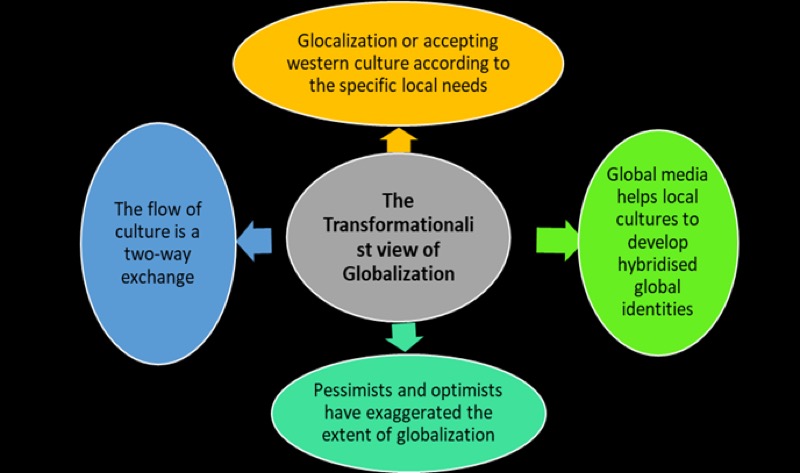
Transformationalists, as well as postmodernists, are of the view that global media is the main driving force diffusing different cultural styles around the world, creating new global hybrid styles in fashion, food, music, eating habits and lifestyle. Apparently, in the postmodern globalized world, cultural diversity and pluralism will become the norm. Transformationalists also argue that Western cultures do not consume local cultures entirely. Instead, relatively few aspects of Western culture are adopted by the people of developing countries. When this does occur, such aspects are said to be adopted according to particular local needs, a process known as 'glocalization.'
In many educational systems around the world, art education is being actively promoted. Students learn about the arts and gain skills in various related genres, ranging from drama and music to crafts, endowing them with a range of talents and abilities. Such students engage in a creative process, including the use of imagination, critical thinking, and physical and mental skills (Engelhardt, 2005). This approach also displays the art, whether by means of visual displays, static objects or performing arts. Ultimately, students develop analytical and interactive abilities which help them acquire creative and innovative new thought patterns in their daily lives.
Visual art elicits inspiration, transformation and a better understanding from the individuals engaged in it. This process is generally aided by guides or trained educators who serve to enhance such effects, helping to achieve a more meaningful understanding of the arts (Welch et al., 2013). Similarly, art museums have effectively developed and implemented various programs to engage and educate young people of different backgrounds.
Galleries have also been very useful in both visible and less visible ways when it comes to supporting artists. They not only promote such individuals by presenting and selling their work, but may also provide them with additional services, such as financial management or book publishing services. Few artists collaborate with one another out of trust or respect, but rather mutual benefit in terms of media exposure. The attention of the public and media is more easily gained as a group than as individuals (Art Fervour, 2020). For example, Frida Kahlo and Diego Rivera; Georgia O'Keeffe and Alfred Stieglitz; and Max Ernst and Dorothea Tanning are just some of the famous artists who have collaborated together in the past (Bozovic, 2017).
In summary, globalization appears to have had a significant effect on the field of visual art and the personal development of visual artists themselves. The following section will examine the literature on these two topics in further detail to better elucidate the relation between them.
2. Literature Review
2.1. Globalization
Over the course of the 1980s, the significance of national boundaries, economies, states, and cultures declined considerably. This paved the way for the development of a theory which could explain such phenomena, in time becoming known as globalization theory. Hay and Marsh (2000) state that Ohmae (1990) is seen as the primary representation of this theory, with other notable works coming from Reich (1991) and Albrow (1996), as well as other studies in the world of business, media, and politics.
Nowadays, many institutions have expanded their ownership portfolios from predominantly national to increasingly multinational investments. Their production facilities, work forces, and customers are now more than ever distributed across the world. A few renowned examples would include Coca-Cola, McDonalds and news organizations with stakes in a variety of media forms, such as newspapers, the internet, television, and various other platforms across different regions (Thompson, 1995; McChesney, 1999).
It is highly debated as to whether globalization has had an equalizing effect on the global population in terms of increasing the well-being of the world's poorest citizens (Wade & Wolf, 2003; Friedman, 2007). National differences have declined or become less prominent as people have continued to adapt to the more successful practices of distinct cultures from various parts of the world (Tomlinson 1999; Sklair 2002; Pieterse 2009). This effect has further increased due to intercultural awareness promoting mechanisms such as the internet, television broadcasts, migration, and international tourism.
According to McGrew (1992), there are two distinct analytical features of globalization. The first is the "sphere of activity" and the second is the "intensity" of the activity. A network of relationships is formed wherein geographic distance becomes an ever less important factor in establishing and developing cross-border economic, political, and socio-cultural relations (Popescu et al., 2004).
Despite certain controversies over its management and social consequences, globalization is currently considered to be a reality which countries must interact with if they seek to maintain ongoing prosperity. If this reality is not accepted by societies and political leaderships, such countries will likely miss additional opportunities for economic growth and social development. Furthermore, by turning their back on globalization, they also risk losing existing positions in world markets (Bari, 2005).
The positive aspects of globalization include the integration of liberalized markets, the circulation of goods and capital, and the elimination of barriers to free trade, services, and information (Călinică & Ioan, 2015). These outcomes promote enhanced economic growth for many economies. While the benefits of growth can be distributed unevenly, this largely leads to more beneficial outcomes for a larger share of the world's population.
The theory of globalization has three main variations, including the globalist, sceptical, and post-sceptical, or transformational perspectives. Globalists propose a worldwide cosmopolitan democracy. Yet the substance of their arguments does more in practice to strengthen the sceptical view of politics based on inequality and conflict, nation-states and regional coalitions, and alliances of common interest or ideology, than promote cosmopolitan global structures (Martell, 2007). For example, in North America and Europe, state identities remain extremely powerful, with global identities not yet capable of replacing them. This is because they possess a comparatively lengthier history in people's minds and maintain a more solid grip on the popular imagination (Martell, 2007).
Sceptics are of the view that the world economy is not a globally inclusive one. For example, regions in Sub-Saharan Africa are much less integrated than those in other parts of world such as East Asia, Europe, and North America. Proponents of this view argue global inequality is on the rise and that protectionism is widespread throughout Europe and the United States in response to the imports of rapidly expanding Asian economies (Martell, 2007). In China, India, and other parts of Asia for example, liberal policies have played an integral role in nurturing and strengthening the global economy. In the very same places however, ongoing protectionism and state intervention cannot be ignored. In a number of African countries, however, many have fallen prey to increasing inequality and poverty. Individuals in such counties have comparatively weak chances of participating in the open global economy in a meaningful way (Wade & Wolf, 2003; Kaplinsky, 2005).
Culturally, it remains up to countries themselves in the way they respond to the opportunities and challenges of globalization (Martell, 2007). Donald's may have expanded seemingly inexorably around the world, but its ingredients vary according to local tastes and customs (Ritzer & Stillman, 2003). While American culture is seen by some as predominant among other cultures around the world, it is not automatic nor necessary that everyone responds positively to the globalization of American culture. This is particularly evident today in countries like France and parts of the Middle East. Globalization theory can thus be seen as extremely generic in nature and universal in its attempted application (Kofman & Youngs, 1996).
2.2. Art and Globalization
When communications and media interact, art and entertainment often prosper. If we take the case of film, it may seem surprising to some that American movies generate a significant portion of their profit from overseas audiences. Mass art does not flow in a single direction. Many Americans and citizens from other parts of the world for instance enjoy Japanese anime and martial arts films from Hong Kong. Hong Kong cinema has particularly influenced the style of Hollywood movies. Indian films are also viewed in Africa, England, and even the United States (Carroll, 2007). Similarly, if we take the example of dance performers, we see that from the beginning of the twentieth century, both Western ballet and modern dance have thoroughly entered East Asia. Russians, such as the Bolshoi dancer George Gontcharov, have for instance exploited the opportunity to commence dance schools in Japan and China. Similarly, artists such as Isadora Duncan and Denishawn have travelled to the Far East and formed a modern dance movement that saw Japanese dancers learn German dance moves during the 1920s and 1930s.
The forces of globalization have also given birth to the field of Contemporary art. Global practices from various regions with diverse cultural heritage and political and social contexts have precipitated the flourishing of art in its current form.
DeMarrais and Robb (2013) explore the various avenues through which art can both modify and help to create a society. Other than observing art aesthetically, one should also examine it through a cultural and sociological lens. They found that art firstly establishes various sites of activity for mutual interaction. Secondly, people make use of different ways to create and assert representational models of art for social relations. Thirdly, art can be used as cultural capital in various ways, distinguishing different members of society through shared forms of knowledge or access. Finally, art can serve as a medium of exclusion and a means of resisting authority or challenging existing power relations.
Gude (2004) asserts that the globalization of art functions in three distinct ways. The first is the work's content. Artists express critical issues and realities taking place in the world. These themes can include issues such as connectivity, polarization, identity, alienation and conformity. The second way lies in the use of imagery. Artists use familiar images of international commerce, politics, or entertainment, but often include or contrast them with local historical or traditional images. The third way involves the artists' use of visual conceptual techniques to convey their ideas to an audience. Such techniques often mimic the mechanisms of globalization, including collision, fusion, and hybridization (Pieterse, 2009). They generally conduct synthesis, layering, superimposition and the recontextualization of artwork. These techniques are frequently employed by contemporary artists to provide greater insight into their work (Gude, 2004).
2.3. International Art Galleries and Exhibitions
The history of art exhibitions is lengthy and complex. They evolve from societies that seek changes in artwork and, at the same time, vocalize those demands. Art exhibitions offer ideas to the public; they provide contemporary audiences with additional insight by presenting, displaying and contextualizing artworks. The main goal of art exhibitions is to maintain the relevancy of art for a society at any given point in time (Cline, 2012).
Art galleries showcase the history of a particular culture in a visual manner. Such visual history takes audiences to the past where they can visualize what life was like during a particular time. Art galleries differentiate between emerging talent and established artists, promoting both to the public at large. In turn, the audience gains a better understanding of different perspectives, encouraging distinct manners of creative thinking (Redins, 2014). Photography and art in galleries can also inspire other artists to create new and dynamic works of their own. Several art galleries around the world attract large audiences by offering tours and even conducting art classes for the public, helping to educate younger generations.
International art exhibitions also play a role in bringing different nations together and put art into more of a global context. Artists are presented with an invaluable opportunity to present a variety of their images through such exhibitions. This work in turn reflects both the differences and commonalities among various cultures (Sherman & Rogoff, 1994).
Artists and the public may also acquainted themselves with art history through the catalogues of exhibitions. These catalogues contain lists of places associated with certain dates and identities, serving as geolocatable data on the deeds and circulations of artists and artworks across the globe. Such data is a useful source for a global approach to art history (Kaufmann et al., 2016). They describe and establish a geography of places, as well as representing symbolic values to specific venues, neighbourhoods, cities, and entire regions of the world. They are used as a strategic tool by the world's artists to circulate their ideas and names while also building global reputations that are not bounded by spatial proximity nor physical borders.
For example, a case study by Holmes (2016) identified an Australian art exhibition called "Emergence" which showcases the work of science and visual artists. Students and various young artists presented their work at the exhibition to showcase their emerging talent. It took place at the La Luna Youth Arts venue in Townsville, Queensland but attracted participants and audience members from all over Central and Northern Queensland.
2.4. Collaboration among Artists
Roberts (2009) finds that collaboration between artists has increased manifold in the last several decades via groups, duos and other kinds of collaborative relations between artists and their audiences. Such collaboration produces artwork of a higher calibre by harnessing the benefits of working together, including greater creativity and the elicitation of additional ideas. Roberts (2009)'s qualitative collective case study provides a more complex view of artistic collaboration in practice and pedagogy. The study's findings suggest that it is very difficult to work collaboratively in any field. A high level of tolerance and trust is required for one to accept other's work, a social phenomenon which takes time to evolve. Furthermore, learning to voice and recognize differences are also important steps to being able to accept them.
According to Dalela (2017), if an artist performs with others who have a similar style and theme, both parties can benefit from an enhanced audience and personality. Similarly, artists tend to promote each other on their respective organic as well as digital channels to further boost their popularity and reach. These collaborations lead to a greater impact at both the regional and global levels, with international collaborations in particular leading to possibly the greatest ideas, thoughts and skills.
2.5. Organizing Workshops and Conferences
Puppe et al. (2020) argue that in order to encourage the professional development of art students, they should practice domain-specific activities. Lectures, workshops and exchanges with fellow students can also help in advancing their development path. Puppe et al. (2020) findings indicate that lectures can be seen as the most helpful resource for the development of professional skills among experts and intermediaries. The responses of amateur students however instead suggested that feedback from family and friends was the most important factor (Puppe et al., 2020).
Emerging art students often acquire the latest skills by attending relevant art conferences in their local areas. It is highly important to remain up to date with emerging research and practices in this industry. Art conferences provide access to new techniques, strategies and tools for developing greater "imagination" skills, as well as additional insight into the creative processes of contemporary artists. They also offer valuable resources, curriculum knowledge, and program ideas to help students and their schools meet the needs of the future collaboratively (Walkup, 2013).
2.6. Visual Art Education
Visual arts are commonly thought of as a fundamental cultural practice in human history. The purpose of visual arts depends on the degree to which individuals seek to document their lives based on aesthetic, educational, economic, cultural or social reasons. Students benefit from visual arts education academically while at the same time experiencing a broader process of personal development. Generally speaking, higher graduation rates are achieved by those belonging to more challenging backgrounds in arts education (Cutcher, 2014). Visual arts education is often regarded as supporting the acquisition of a wide set of skills, such as imagination, creativity and innovation. Lectures provide aspiring artists and art educators with new ideas that can help guide the trajectory of their work.
Duncum (2001) discusses the theoretical foundation of an art education that takes global culture into account. The argument reviews and critiques the popular theory of cultural imperialism in which US culture is seen as spoiling and engulfing national and local cultures. Duncum (2001) claims that a complex set of cultural issues can be examined if we analyse them through the lens of reading reception theory and theories of indigenization and cultural translation. Such theories advocate heterogeneity and human agency instead of homogeneity and passivity. Moreover, they also emphasize variety, diversity and the richness of popular and local cultural practices that resist and interact with the cultural goods of global capital.
Visual arts teachers are trained as both art specialists and educators. These two categories make visual arts education a unique experience for artists and art teachers alike. Several types of training are available to such specialists, ranging from a master's degree in art, focusing primarily on visual arts, to a master's degree in education, focusing more on professional and general education.
Many multicultural art projects have occurred over the course of the past decade, ranging from a preparation program for in-service and pre-service teachers that educate students from diverse cultural backgrounds, to a large school district curriculum project in which art is one of many curriculum areas incorporated into a multicultural education approach (Rodriguez & Sherman, 1983). Despite such examples however, in overall terms, there have been relatively few art programs and projects devoted to multicultural education over the past decade. Since the late 1970s, art education textbooks emphasizing cultural pluralism and multiculturalism have all but disappeared. The issue of cultural pluralism nevertheless persists among art educators today.
2.7. Sharing Artistic Experiences
To encourage others to engage with art, Cowinie (2018) believes in sharing artistic experiences. Sharing experiences and personal stories can be an effective way to connect with like-minded individuals. Artists are more likely to engage the audience in their work by taking them on a journey or sharing the story behind it. In short, an overriding narrative will mean more to them than simply looking at the art in isolation. The audience will invest more in the artist's work emotionally and the more they understand it, the more it will be appreciated.
Larsson (2018) interviewed several artists who talked about their experiences with art and the difficulties they faced over the course of their careers. Personal stories included selling their paintings to local dealers, struggling in the field of photography and videography, using photography as therapeutic medicine for psychological problems, and being hired as extras before becoming professional artists.
After a certain amount of time, an artist will have accumulated a relatively diverse array of experiences. However, not every life experience will have directly impacted their development as an artist. Generally speaking, art followers want to know more about the growth and experiences directly related to an artist, especially if this strengthens the meaning behind the artwork itself (Sherwin, 2013).
2.8. Sharing Artwork
A good way for artists to meet and share their art work in an enjoyable and comfortable environment is by enrolling in workshops, attending conferences and symposia where they can advance their skills or learn a new medium. Such occasions are constructive places to meet all kinds of artists with whom one can learn, share ideas, and talk to about their art work.
Similarly, in online communities such as those found on Facebook, an artist can join groups with hundreds of other professionals to share their art and knowledge. From sharing events and calls for entries to posting artwork for sale and tips on how to succeed as an artist, Facebook groups are a quick and productive way to connect with others and see what those in the community are doing. Studio tours are not only for art collectors and fans, but also a fun way to meet fellow artists, learn about others' style and approach, and experience what it's like to be in another artist's creative space.
Joining artist communities and connecting with others can be of great benefit. It allows one to view how others plan their careers, save time, avoid stress, and network with influential people in the industry (Artwork Archive, 2022).
3. Research Questions
This study seeks to address the following six research questions:
1. How would lectures and art workshops be beneficial for artists, academics and art learners to better understand the globalization of visual arts and its importance?
2. What kind of experiences and knowledge can different artists share during conferences and symposia that can benefit other artists?
3. Why are international art galleries considered helpful in spreading global cultural art?
4. Why is artistic collaboration healthy for the development of artists' careers?
5. Why are local museums facing difficulties in displaying globalized art?
6. What are the perceptions of art faculty and post-graduate students concerning visual arts and globalization?
These are the six research questions to be addressed in this study. The next section details the methodological considerations taken in an attempt to address these research questions.
4. Methodology
The aim of this study is to identify the relationship between visual arts and globalization, paving the way for additional artists and art educators around the world to collaborate with each other at the global level. The above-mentioned research questions are examined through an empirical investigation of contemporary art using a self-made scale for visual arts and globalization questionnaire. In conducting the investigation, the transformationalist theory of globalization is adopted. This line of thinking views humans as constantly interacting with the world, a necessary exchange for their personal growth (Giddens, 1984).
The research undertaken here on globalization and visual arts focuses on globalization as a historical phenomenon that is still changing lives and will likely continue to do so in the future. Transformationalism does not maintain a fixed view of globalization, but rather perceives it as an ever-changing spatio-temporal phenomenon. The concept of the "self" in this school of thought enhances the artists' vision. When an artist travels around the world, they gain new experiences which can enhance their personal growth.
This study was conducted in the College of Design and Art, Umm Al-Qura University, Saudi Arabia. The study sample comprised a total of forty-two participants, including post-graduate students, teaching assistants, lecturers, assistant professors and associate professors.
A consent form outlining the purpose of the research along with a guarantee that the data will be used for academic purposes only was filled by the participants prior to the study. Those willing to participate signed the form and were free to withdraw at any time.
The participants signed the demographic data page before providing their responses. This information was collected to determine demographics had an effect on the responses given.
A qualitative research design was employed, allowing for a more detailed exploration of the various ways through which artists work with each other. An open-ended questionnaire was used to elicit detailed responses on the perceived relationship between visual arts and globalization.
The participant inclusion criteria were set according to the availability of art faculty and post-graduate students. The self-made scale on visual arts and globalization was then administered. The scale consisted of twenty-one items related to the research questions. The participants were given the choice of sharing their perceptions on visual arts and globalization in the form of brief answers.
The survey was conducted with the use of the SurveyMonkey online platform. Participants were initially contacted before being sent the scale along with the consent form and demographic data sheet. The average time taken to participate in the questionnaire, or data collection time, was approximately two weeks. The data gathered was then analysed through the use of a deductive method of qualitative analysis, with various themes generated on the basis of the participants' responses.
5. Results
To examine the relationship between visual arts and globalization, as well as how this may help to enhance the personal development of artists, responses from the questionnaire were grouped into various categories. The tables of results are presented below, followed by a thematic analysis of the data based on the particular research questions addressed.
5.1. Tables of results
The data was collected from the College of Design and Art faculty and post-graduate students to observe their vision regarding the role of globalization in shaping visual arts. The collected data was analysed using SPSS 22.0 and reported in tabular form. The results include percentages and frequencies related to the demographic data of the participants. ANOVA test was applied on the job-positions of the participants. A correlational analysis was also done between the items of the scale to check the significance of the inter-item relationship. The results and interpretations of the collected data are discussed below.
| Variables | Categories | f (%) |
|---|---|---|
| Gender | Female | 37 (88.1) |
| Male | 5 (11.9) | |
| Profession | Teaching Assistant | 2 (4.8) |
| Lecturer | 9 (21.4) | |
| Assistant Professor | 7 (16.7) | |
| Associate Professor | 9 (21.4) | |
| Post-Graduate Students | 15 (35.7) |
Table 1 indicates that the sample of the present study constitutes of academics and post-graduate students of different positions and gender. The descriptive percentages are showing that the biggest part of the sample was females - 88.1% and 11.9% were males. By looking at the job positions of the sample, 4.8% were teaching assistants, 21.4% were lecturers and associate professors, 16.7% were assistant professors and the majority was post-graduate students - 35.7% of the total sample.
| Variables | Teaching Assistant (n=2) M SD | Lecturer (n=9) M SD | Assistant Professor (n=7) M SD | Associate professor (n=9) M SD | Student (n=15) M SD | F |
|---|---|---|---|---|---|---|
| Q1 | 1.50 .70 | 1.44 .72 | 1.14 .37 | 1.44 .52 | 1.46 .63 | .39 |
| Q2 | 1.00 .00 | 1.77 .66 | 1.71 .48 | 1.77 .66 | 1.46 .51 | 1.23 |
| Q3 | 3.50 .70 | 3.44 .88 | 3.57 .78 | 3.33 1.11 | 3.40 1.18 | .05 |
| Q4 | 1.5 .70 | 1.44 .52 | 1.57 .53 | 1.55 .52 | 1.53 .51 | .07 |
| Q5 | 2.00 1.41 | 1.66 .50 | 2.14 .69 | 1.55 .52 | 1.60 .50 | 1.38 |
| Q6 | 1.50 .70 | 1.44 .52 | 1.71 .48 | 1.33 .50 | 1.26 .45 | 1.05 |
| Q7 | 1.00 .00 | 1.44 .52 | 1.42 .53 | 1.44 .52 | 1.33 .48 | .40 |
| Q8 | 1.00 .00 | 1.44 .72 | 1.28 .48 | 1.33 .50 | 1.26 .45 | .34 |
| Q9 | 4.50 .70 | 3.55 .72 | 3.00 .81 | 3.0 1.11 | 3.86 .91 | 2.44 |
| Q10 | 2.0 .00 | 1.66 .50 | 1.57 .53 | 2.11 .33 | 1.33 .48 | 4.32 |
| Q11 | 1.50 .70 | 2.55 .52 | 1.85 .69 | 2.11 .92 | 2.46 .83 | 1.63 |
| Q12 | 4.50 .70 | 3.66 .70 | 3.57 .53 | 3.00 1.1 | 3.60 1.18 | 1.20 |
| Q13 | 2.00 1.41 | 2.88 .78 | 2.42 .97 | 2.0 .70 | 2.93 1.03 | 1.93 |
| Q14 | 2.00 1.41 | 2.55 .88 | 2.71 .95 | 2.33 .86 | 2.73 1.09 | .43 |
| Q15 | 2.00 1.41 | 1.77 .44 | 2.28 .75 | 2.11 .78 | 1.73 .45 | 1.23 |
| Q16 | 2.50 .70 | 2.77 .83 | 2.57 .78 | 2.00 .86 | 2.13 .63 | 1.64 |
| Q17 | 1.00 .00 | 2.00 .50 | 2.14 .89 | 1.77 .83 | 1.8 .67 | 1.14 |
| Q18 | 1.50 .70 | 2.11 .60 | 1.42 .53 | 2.00 .86 | 1.66 .61 | 1.48 |
| Q19 | 1.50 .70 | 1.88 .33 | 1.42 .53 | 1.66 .50 | 1.60 .73 | .68 |
| Q20 | 1.50 .70 | 1.55 .72 | 1.57 .53 | 1.66 .50 | 1.14 .36 | 1.72 |
*p< .05, **p< .01
Df = 41
Table 2 shows the comparison between job positions of the sample and scale. No significant results can be seen between the two, when looking at the F value. The mean values of the sample also vary according to the job positions. No specific category is showing whether there is a positive or a negative relationship between visual arts and globalization.
| Q1 | Q2 | Q3 | Q4 | Q5 | Q6 | Q7 | Q8 | Q9 | Q10 | Q11 | Q12 | Q13 | Q14 | Q15 | Q16 | Q17 | Q18 | Q19 | Q20 | |
|---|---|---|---|---|---|---|---|---|---|---|---|---|---|---|---|---|---|---|---|---|
| Q1 | - | .39* | -.13 | .17 | .12 | .42** | .46** | .46** | .10 | .16 | .28 | .08 | .16 | .35* | -.11 | .28 | .31* | .16 | .36* | .62** |
| Q2 | - | - | .12 | .28 | .38* | .37* | .17 | .32* | -.04 | .33* | .06 | -.02 | .11 | -.08 | .25 | .39* | .27 | .21 | .23 | .43** |
| Q3 | - | - | - | -.31* | .17 | -.06 | -.24 | -.07 | .35* | -.11 | .07 | .33* | .13 | .01 | .08 | -.09 | -.08 | -.29 | -.36* | -.15 |
| Q4 | - | - | - | - | .34* | .49** | .45** | .48** | -.29 | .34* | -.04 | -.12 | -.05 | -.12 | .19 | .40** | -.05 | .26 | .32* | .48** |
| Q5 | - | - | - | - | - | .64** | .13 | .37* | .12 | .28 | -.09 | .25 | .30 | -.04 | .32* | .36* | .24 | -.03 | .05 | .29 |
| Q6 | - | - | - | - | - | - | .55** | .54** | -.02 | .37* | -.02 | .15 | .14 | .16 | .17 | .58** | .30 | .04 | .17 | .59** |
| Q7 | - | - | - | - | - | - | - | .58** | -.05 | .25 | .05 | .13 | .02 | .19 | -.06 | .23 | .22 | -.04 | .14 | .59** |
| Q8 | - | - | - | - | - | - | - | - | -.02 | .32* | .03 | .05 | .01 | .02 | -.00 | .10 | .18 | -.01 | -.02 | .46** |
| Q9 | - | - | - | - | - | - | - | - | - | .02 | .17 | .53** | .19 | .13 | -.02 | -.09 | -.21 | -.12 | -.06 | -.03 |
| Q10 | - | - | - | - | - | - | - | - | - | - | -.00 | .13 | -.28 | .02 | .35* | .23 | -.00 | .38* | .05 | .52** |
| Q11 | - | - | - | - | - | - | - | - | - | - | - | -.02 | .30 | .40** | .18 | .20 | .23 | .19 | .26 | .06 |
| Q12 | - | - | - | - | - | - | - | - | - | - | - | - | .37* | .29 | .13 | .11 | -.06 | -.04 | -.09 | .08 |
| Q13 | - | - | - | - | - | - | - | - | - | - | - | - | - | .28 | .15 | .24 | .26 | .12 | .26 | .06 |
| Q14 | - | - | - | - | - | - | - | - | - | - | - | - | - | - | .18 | .06 | .12 | .19 | .15 | .16 |
| Q15 | - | - | - | - | - | - | - | - | - | - | - | - | - | - | - | .14 | -.02 | .13 | -.07 | .20 |
| Q16 | - | - | - | - | - | - | - | - | - | - | - | - | - | - | - | - | .34* | .31* | .43** | .39* |
| Q17 | - | - | - | - | - | - | - | - | - | - | - | - | - | - | - | - | - | .03 | .22 | .13 |
| Q18 | - | - | - | - | - | - | - | - | - | - | - | - | - | - | - | - | - | - | .73** | .39* |
| Q19 | - | - | - | - | - | - | - | - | - | - | - | - | - | - | - | - | - | - | - | .42* |
| Q20 | - | - | - | - | - | - | - | - | - | - | - | - | - | - | - | - | - | - | - | - |
**p < 0.01, *p < 0.05
Table 3 demonstrates the Pearson correlation between the items of the Visual arts and globalization scale (VAGS). Many items are significantly and positively correlated with the items (p<0.01, p<0.05). Some items did not show any significant correlations between each other (p>0.05) and some items show negative significant correlation (-) with each other. The overall result of Pearson correlation is not significant, as many items are not significantly related with each other either positively or negatively.
5.2. Experience Sharing in Art Workshops and Lectures
The first thematic analysis addresses research questions number one and two concerning the importance of conducting art workshops and lectures, as well as sharing art experiences and knowledge for enhancing the personal development of art faculty and post-graduate students.
The majority of participants (40 out of 42 participants, 95.24%) agreed or strongly agreed with the importance of workshops and lectures in disseminating art knowledge to a broader audience. They also appeared to believe that lectures and workshops delivered by professional artists and art educators not only increased learners' art knowledge, but also helped them to gain a better understanding of other cultures. Workshops were also seen as beneficial in that they help in triggering artists' creative abilities. Listening to various experiences and narratives shared by artists can change one's perception about art. Nakamura (2009) argues that each individual has a unique way of thinking, making them creative in their vision and methodology. Art education should be not only limited to training on artistic creations, but also help students to visualize a creative process they may leverage to grow in the contemporary context of accelerated globalization. Furthermore, art education should also be capable of developing critical thinking skills, allowing students to better appreciate the value of different kinds of art. Lachapelle et.al. (2003) propose the Model of Aesthetic Understanding, arguing that due to the cognitive functions taking place during the process, art education is most impactful when one views different types of art. Learning is more affective when an art educator shares knowledge that is genuine and unique, not simply historical stories. Instead of becoming the passive recipients of art history lectures, students should learn the skills required for viewing artwork in a way that maximizes their own understanding and enjoyment of the work (Lachapelle et.al., 2003).
5.3. International Art Galleries
The second thematic analysis addresses research question number three on the importance of international art galleries. 41 out of 42 participants (97.62%) were positive or very positive in their view of such galleries. Many considered them to be important because of the large volume of knowledge one is able to gain by viewing art from around the world. 38 out of 42 participants (90.48%) claim that art in general is even capable of changing the world. Art can facilitate better international relations with other countries, thus indirectly contributing to the promotion of local art to global communities. Today, the young generation is increasingly taking an interest in international galleries and museums thanks to advancements in technology, allowing them to enjoy virtual art and gain additional knowledge about other cultures.
An international exhibition is the embodiment of a multitude of choices, individuals, cultures and sometimes misconceptions. There are always alternative art histories to be revealed and new stories to be told at such events. Exhibitions and art galleries serve as the pre-eminent platform for this kind of storytelling. Exhibitions should therefore keep up to date with popular interests to remain relevant both within and outside society (Cline, 2012).
5.4. Artistic Collaboration
The third thematic analysis addresses the research question concerning collaboration as a healthy initiative for artists' professional and personal growth. A majority of the respondents (41 out of 42, 97.62%) held positive or very positive views on the collaboration of various artists for the purpose of enhancing their artwork. Whether they relate to the same or different fields, collaboration almost always facilitates positive outcomes, including the sharing of unique experiences and knowledge which can help other artists experiencing difficulty in creating unique works or masterpieces of their own. All 42 participants (100%) indicated that visual art workshops are a great place to get in touch with other artists, as well as academics, and art educators. Such a connection might benefit them in growing their network, boosting their career.
Collaborative art could also be helpful in eliciting difficult conversations about pressing social issues. Community-based art, neighbourhoods, libraries and museums all play a vital role in bringing communities together, not only helping to enhance individual and community well-being, but also targeting prevalent societal issues such as inequality. Collaboration creates a gender, race and ethnicity free, friendly environment for everyone who wishes to take part (Bublitz et al., 2019). Barbour et al. (2007) state that artistic collaboration focuses on creative processes and fostering relationships between those involved instead of simply the creation of an art piece. Collaboration serves as a platform through which professional values are given a high degree of importance and shared agendas may emerge.
5.5. Difficulties Faced by Local Museums and Galleries
The fourth thematic analysis addresses the research question concerning the difficulties faced by local museums in displaying global art. A majority of the participants (85.71%, 36 out of 42 participants) held the view that the decline in prominence of local museums is due to a lack of policies and often low budgets. Local museums are frequently confronted with obstacles to attract large audiences due to a lack of unique artworks and the various technologies employed by many international galleries.
Recent technological advancements in the realm of digitalization appear to have precipitated a wider decline in museum audience numbers. This is arguably because the internet and other digital mediums allow people to view many artworks from the comfort of their own homes, without the need to physically visit institutions. Furthermore, with the advancement of globalization and the increasingly capitalistic nature of many national economies around the world, novel pressures and norms are leading people to spend more time in formal employment and less time engaged in leisure activities, including visiting local libraries and museums (Burton & Scott, 2003).
It is not surprising then that there is often a weak connection between museums and globalization. Globalization is always evolving, yet museums continue to rely on benefactors to maintain demonstrable social function. Existing museums tend to find it difficult to survive, while new and underdeveloped museums are able to rely on the fundamentals of global art (Young, 1999).
5.6. General Perceptions of Participants
The fifth thematic analysis addresses the research questions concerning the participants and their general perceptions on visual arts and globalization. All participants (100%, 42 out of 42) considered that sharing different art experience and knowledge with other artists is beneficial. However, regarding working with people from different cultural backgrounds, although still a majority, only 54.76% of the participants (23 out of 42) viewed it as beneficial.
Nevertheless, sharing experiences and knowledge is beneficial and globalization has a positive role in enhancing and disseminating visual arts overall, it is as a driving force towards the growth of artists and the development of their artwork. Such perceptions also supported the transformationalism school of thought's assertion that individuals require a collaborative, non-individualistic environment to support their personal growth. In the case of art, the growth of an artist can be further enhanced by spending time in a community of diverse cultures, backgrounds and knowledge.
The art world of the past appears to have been relatively far removed from globalization, as the values and customs of artwork were often both based upon and enjoyed by those of distinct regional and national cultures. Today, however, the art world has a unified and common agenda, involving a shared language, set of games and series of traditions that are spreading across the globe. Advancements in communication and transportation technologies have made the interconnections between galleries, museums and large-scale exhibitions more numerous and intense than ever. While some institutions may remain relatively dislocated from this phenomenon, many are now beginning to connect their local art with global art audiences, both physically and virtually (Carroll, 2007).
In summary, this section has outlined the thematic analyses of experience sharing in art workshops and lectures, international art galleries, artistic collaboration, the difficulties of local museums and galleries, and the general perception of art educators. The following section provides a discussion of these results in context.
6. Discussion
This analysis explores the various ways through which artists can work together and share their artwork with each other at the global level. The Transformationalism theoretical perspective of globalization was adopted in an attempt to demonstrate how both aspiring artists and art educators can benefit from the forces of "globalization". Presently, globalization is one of the most common topics in the scientific literature, as well as in arts, fiction and advocacy. Since the 1980's, art markets outside of Europe and the US have grown rapidly. China, Russia, Brazil, Japan and India in particular have demonstrated impressive growth in contemporary art (Velthuis, 2015). With the rise of art markets in such countries, other nations have also stepped forward to create a global integration of artists. The current wave of globalization in art markets, beginning at the end of the 20th century and coinciding with a moment of wider economic and cultural globalization, is particularly strong today. Another important part of societies' art infrastructure would be art fairs and exhibitions. While art fairs were once small in number and relatively unimportant, since the 1990s they have become the global art market's flagship event. Moreover, fairs are also important cultural events for local art milieus, with tens of thousands of visitors, many contemporary art side shows, and a series of talks and debates held by well-known curators, collectors, intellectuals, and artists.
The most common aspect of transformationalism is cultural adoption. Transformationalists view global media as beneficial for diffusing different cultural styles around the world and creating new global hybrid styles in the realm of fashion, food, music, consumption and lifestyle. For example, in the US, many TV shows have been adapted from other countries but skilfully fused into US culture to make them more appealing to local residents. These 'glocalized' programs tend to add a local spin on the original premise to make it nearly indistinguishable from a local product. Indeed, viewers of such shows are often unaware that what they are watching is a version of something originally developed elsewhere (Bielby & Harrington, 2002).
International art galleries and exhibitions appear to be effective ways through which to bring different global artists together and demonstrate other cultures to the world. Artists from various regions can display their artwork as a medium to promote their culture. Adults, children and elders can also benefit from galleries by increasing their knowledge and sense of aesthetic appreciation. For instance, while children can read about art or a certain period of time in books or online, it is often much more meaningful to see the relevant pieces of art and artefacts in person. The art and photographs found in art galleries can also inspire people to create new and dynamic works of their own. Many art galleries even offer tours and art classes to the general public. These classes work to educate a new generation of art enthusiasts and artists alike. Duncum (2001) views art classrooms as "crucial sites for discussing issues raised by global culture" and sees students of visual culture as capable of imagining "alternative projects of social existence". This means that art educators should attempt to understand the complexities and interconnections between globalized phenomena before seeking to promote the potential and talents of students.
The dominant art exchanges today still take place through biennials, a common Italian term used to describe international contemporary art exhibitions, and other large-scale art events. According to data collected by the Biennial Foundation, there are currently more than two hundred contemporary art biennials operating all over the world. The Venice Biennale, which is the oldest having been created in 1895, is based on national pavilions (official country participations) yet each year includes new, formerly unrepresented countries. The last several editions of the Documenta exhibition, which has been running since 1955 in Kassel, Germany, have attempted to expand to other locations. Among the biennials which have been in the forefront of globalization are those in Istanbul, Sharja, Taipei, Gwangju, Berlin, Sydney, Shanghai, Lyon, Havana, Moscow, Bucharest and Dakar (Dimova & Gillen, 2017). In East Asia, hundreds of museums and centres for contemporary art have been created in the last decade. In Japan for instance, department stores have even opened their own galleries. In China, a museum is seen as a symbol of civility and modernity which corresponds better to the state authority's control over culture than an art fair or a biennial.
Over the course of the past several decades, both artistic practice and collaboration have increased rapidly. Hobbs (1984) states that "artists conceive and make art, but all of us collaborate in creating its cultural role". Artists, teachers, art educators and students can grow meaningfully if they adopt the art of education. Art teachers and students can work together to explore the various ways through which they can enhance their understanding of both themselves and the world, as well as consider how the use and creation of visual forms might facilitate such learning. Individual collaborations can also morph into creative learning communities in which artists share techniques and artworks with those seeking to learn something new.
Regular art galleries and exhibitions, artistic collaboration between individuals of distinct cultures, and lectures and workshops from esteemed art educators can all aid aspiring artists in taking advantage of globalization and furthering their personal development. These steps can have a significant impact when it comes to such objectives and should therefore be encouraged both by civil society and through the help of government policies.
Few studies to date have addressed the concepts covered here. The sample that the questionnaire was administered on did not consist of visual artists themselves, but rather art educators and students from the College of Design and Arts, Umm Al-Qura University, Saudi Arabia. The results obtained from the self-made scale yielded various themes addressing the research questions on the relationship between visual arts and globalization, as well as how aspiring artists can best utilize globalization.
The study makes use of open-ended questions eliciting sufficiently rich responses to address the importance of international art galleries, the benefits of artistic collaboration, the challenges faced by local museums and galleries, and the shared artistic experiences and perceptions of art teachers and students on visual arts and globalization. The forty-two participants involved shared their thoughts and opinions on the topic, the majority emphasizing the positive role of globalization in shaping visual arts and the personal development of artists.
The study also made use of a systematic approach to the literature on visual arts and contemporary art and globalization. The research design was qualitative, with virtual observation adopted through the SurveyMonkey online tool. Digital technologies offer an efficacious way to reach a greater number of people, as the majority of citizens in many societies now use social media. The role of government and politics is also an important factor in determining how globalization can benefit visual artists. To promote a transformationalist globalization approach to visual arts, the local population and government should work together with artists to encourage globalized art at all levels.
In the contemporary world, an increasing number of service mediums are now digital, meaning artists should remain active on social media where a large and receptive audience can be found. Due to the effects of the Covid-19 pandemic, many activities have moved from the personal to the virtual realm. In online communities such as those found on Facebook, Instagram, Twitter, and Tumblr an artist can interact with hundreds of fellow professionals to share their artwork and knowledge. From sharing events and calls for entry to the posting of artwork for sale and tips on succeeding as an artist, groups represent a quick and accessible way both to link up with and see what others have achieved in the artist community.
7. Conclusion
Globalization is often referred to when talking about the economy and trade, but less frequently in the field of art. This research has contributed to the field of visual art and globalization by elucidating the various ways through which artists can work together to create unique artworks. What one learns from art's relationship with globalization is that there is no fixed culture or authentic identity when it comes to art. Art promotes new forms of cultural identity on the basis of cultural specificities and history, maintaining a particular focus on flexibility in the pursuit of broader common goals. Distinct cultures, when combined through art, create a sense of belonging and shared ideas which serve to enhance knowledge of the unknown. Artists, art educators and students, along with relevant governmental policies, make this possible.
This study has adopted the Transformationalist approach, arguing that humans are in a constant state of evolution and that the personal growth of an artist is necessary for their success. With such a perspective in mind, relevant research questions were designed and the opinions of academics and post-graduate students in the field of arts were recorded. The results addressed the research questions by elucidating the perceived relationship between visual arts and globalization. However, there are various limitations which should be addressed in further research. The sample size, for instance, was not large nor diverse enough to generalize the results. A sample consisting of artists could have also been useful in the survey. Additionally, the self-made scale does not possess sufficient psychometric properties due to time and resource constraints, posing reliability and validity problems.
To address and overcome these limitations, future research should focus on the various ways to encourage a greater number of international art galleries displaying artwork from different cultures around the world. It should also focus on how to promote workshops and seminars for artists and deliver lectures about aesthetics for the purpose of educating artists, academics, and art educators on the importance of globalization for visual arts and artistic collaboration. Additionally, governments should come forward to initiate and hold conferences, symposia, and forums for visual art. Another recommendation would be to encourage artists to present their artwork in exhibitions and conferences to teach artists from other countries and cultures the techniques and methods related to their work. Such actions would allow different artists to share and benefit from the experiences of others by offering compelling narratives related to their work.
References
- ALBROW, M. (1996). The Global Age: State and Society Beyond Modernity. Cambridge: Polity Press.
- ART-FERVOUR. (2020, May 16). Co-creating Brilliance: Famous Artistic Collaborations. Retrieved March 2, 2022, from Art Fervour: https://www.artfervour.com/post/timeless-collaborations-a-look-at-memorable-duos-of-the-art-world
- ARTWORK-ARCHIVE. (2022). How to Connect with Other Artists and Boost Your Art Business. Retrieved March 02, 2022, from Artwork Archive: https://www.artworkarchive.com/blog/how-to-connect-with-other-artists-and-boost-your-art-business
- BARBOUR, K., RATANA, D., WAITITI, C., & WALKER, K. (2007). Researching collaborative artistic practice. Waikato Journal of Education, 13(1), 49-77.
- BARI, I. (2005). Globalizarea Economiei (Globalization of the economy). Bucharest: Economică.
- BIELBY, D. D., & HARRINGTON, C. L. (2002). Markets and Meanings: The Global Syndication of Television Programming. In D. Crane, N. Kawashima, & K. Kawasaki (Eds.), Global Culture: Media, Arts, Policy, and Globalization (pp. 215–232). New York, NY: Routledge. doi:10.4324/9781315538792
- BOZOVIC, N. (2017). The Creative Process. Retrieved March 21, 2022, from Agora Gallery: Famous Art Collaborations: Art collaborations simply cannot be a bad idea: https://www.agora-gallery.com/advice/blog/2017/04/27/famous-art-collaborations
- BUBLITZ, M. G., RANK-CHRISTMAN, T., CIAN, L., CORTADA, X., MADZHAROV, A., PATRICK, V. M., ... TOWNSEND, C. (2019). Collaborative Art: A Transformational Force within Communities. Journal of the Association for Consumer Research, 4(4), 313-331. doi:10.1086/705023
- BURTON, C., & SCOTT, C. (2003). Museums: Challenges for the 21st Century. International Journal of Arts Management, 5(2), 56-68.
- CĂLINICĂ, R. M., & IOAN, V. (2015). Approaches and Controversies of the Globalization: The Possible Effects of Globalization. In E. Lukács (Ed.), Proceedings of the International Conference "Risk in Contemporary Economy" XVIth Edition (23-24 April, 2015) (pp. 353-358). Galati: Faculty of Economics and Business Administration, University of Galati.
- CARROLL, N. (2007). Art and Globalization: Then and Now. The Journal of Aesthetics and Art Criticism, 65(1), 131–143. doi:10.1111/j.1540-594X.2007.00244.x
- CLINE, A. C. (2012). The Evolving Role of the Exhibition and its Impact on Art and Culture. Unpublished B.A. Thesis. Hartford, CT: Trinity College. Retrieved March 2, 2022, from https://digitalrepository.trincoll.edu/theses/267
- CUTCHER, A. (2014). Drawing on Experience: The Challenges that Generalist Teachers Face in Delivering Visual Arts Effectively in Primary School. Australian Art Education, 36(1), 65-83.
- DALELA, S. (2017, February 24). Why Collaboration Is The Way to Grow As An Artist. Retrieved March 02, 2022, from Dextra: https://medium.com/dex-tra/why-collaboration-is-the-way-to-grow-as-an-artist-58f17bc4e918
- DEMARRAIS, E., & ROBB, J. (2013). Art makes society: An introductory visual essay. World Art, 3(1), 3-22. doi:10.1080/21500894.2013.782334
- DIMOVA, D., & GILLEN, E. J. (2017). Globalization and Cultural Identity: The Perspective of Contemporary Art. In J. Habich (Ed.), The 16th Salzburg Trilogue, 20 August 2017 (pp. 60-71). Gütersloh: The Bertelsmann Stiftung.
- DUNCUM, P. (2001). Theoretical Foundations for an Art Education of Global Culture and Principles for Classroom Practice. International Journal of Education & the Arts, 2(3), 1-15.
- ENGELHARDT, R. A. (2005). Introduction: The role of the arts in improving the quality of education. In E. Meleisea (Ed.), Educating for Creatitvity: Bringing the arts and culture into Asian education (pp. 1-3). Bangkok: United Nations Educational, Scientific and Cultural Organization (UNESCO).
- FRIEDMAN, T. L. (2007). The World is Flat: A brief history of the twenty-first century. New York: Picador.
- GIDDENS, A. (1984). The Constitution of Society. Cambridge: Polity Press.
- GUDE, O. (2004). Postmodern principles: In search of a 21st century art education. Art Education, 57(1), 6-14. doi:10.1080/00043125.2004.11653528
- HAY, C., & MARSH, D. (2000). Introduction: Demystifying Globalization. In C. Hay, & D. Marsh (Eds.), Demystifying Globalization (pp. 1-17). London: Macmillan Press Ltd.
- HOBBS, R. C. (1984). Rewriting History: Artistic collaboration since 1960. In C. J. McCabe (Ed.), Artistic collaboration in the twentieth century (pp. 63-87). Washington, D.C: Smithsonian Institution Press.
- HOLMES, A. M. (2016). Case study: 'Emergence' exhibition - regional artists and scientists in collaboration. In C. Perkins (Ed.), RUN Regional Futures Conference, 21-24 June 2016 (pp. 1-4). Rockhampton: Central Queensland University.
- KAPLINSKY, R. (2005). Globalization, Poverty, and Inequality. Cambridge: Polity Press.
- KAUFMANN, T. D., DOSSIN, C., & JOYEUX-PRUNEL, B. (2016). Introduction: Re-introducing Circulations: Historiography and the Project of Global Art History. In T. D. Kaufmann, C. Dossin, & B. Joyeux-Prunel (Eds.), Circulations in the Global History of Art (pp. 1-22). New York: Routledge. doi:10.4324/9781315572062
- KOFMAN, E., & YOUNGS, G. (1996). Introduction: Globalization – The Second Wave. In E. Kofman, & G. Youngs (Eds.), Globalization: Theory and Practice (pp. 1-8). London: Pinter.
- LACHAPELLE, R., MURRAY, D., & NEIM, S. (2003). Aesthetic Understanding as Informed Experience: The Role of Knowledge in Our Art Viewing Experiences. Journal of Aesthetic Education, 37(3), 78–98. doi:10.2307/3527305
- LARSSON, N. (2018, October 30). How to make a living from your art: Young artists share their stories. The Guardian. Retrieved March 04, 2022, from https://www.theguardian.com/education/2018/oct/30/how-to-make-a-living-from-your-art-young-artists-share-their-stories
- MARTELL, L. (2007). The Third Wave in Globalization Theory. International Studies Review, 9(2), 173–196.
- MCCHESNEY, R. W. (1999, Nov.,11). The New Global Media. The Nation. Retrieved February 10, 2022, https://www.thenation.com/article/archive/new-global-media/
- MCGREW, A. G. (1992). Conceptualizing Global Politics. In A. G. McGrew, & P. G. Lewis (Eds.), Global Politics: Globalization and the Nation States (pp. 1-7). New York: Wiley.
- NAKAMURA, K. (2009). The Significance of Dewey's Aesthetics in Art Education in The Age of Globalization. Educational Theory, 59(4), 427-440. doi:10.1111/j.1741-5446.2009.00329.x
- OHMAE, K. (1990). Borderless World. London: HarperCollins Publishers.
- PIETERSE, J. N. (2009). Globalization and Culture: Global Mélange. Lanham, MD: Rowman & Littlefield.
- POPESCU, I. A., BONDREA, A. A., & CONSTANTINESCU, M. I. (2004). Globalizarea: Mit si realitate (Globalization: Myth and reality). Bucharest: Economică.
- PUPPE, L., JOSSBERGER, H., STEIN, I., & GRUBER, H. (2020). Professional Development in Visual Arts. Vocations and Learning, 13(1), 389–417. doi:10.1007/s12186-020-09246-0
- REDINS, L. (2014, May 09). Why are Art Galleries Important? Retrieved February 12, 2022, from Mehta Art Gallery: http://www.mehtaartgallery.org/why-are-art-galleries-important
- REICH, R. B. (1991). The Work of Nations: Preparing Ourselves for 21st Century Capitalism. New York: Knopf Publishing.
- RITZER, G., & STILLMAN, T. (2003). Assessing McDonaldization, Americanization and Globalization. In U. Beck, N. Sznaider, & R. Winter (Eds.), Global America? The Cultural Consequences of Globalization (pp. 30-48). Liverpool: Liverpool University Press.
- ROBERTS, T. L. (2009). Collaboration in Contemporary Artmaking: Practice and Pedagogy. Unpublished Doctoral Dissertation. Columbus: The Ohio State University.
- RODRIGUEZ, F., & SHERMAN, A. (1983). Cultural Pluralism and the Arts: A Multicultural Perspective for Teacher Trainers in Art and Music. Lawrence, KS: University Press of Kansas.
- SHERMAN, D. J., & ROGOFF, I. (1994). Introduction: Frameworks for Critical Analysis. In D. J. Sherman, & I. Rogoff (Eds.), Museum Culture: Histories, Discourses, Spectacles (pp. ix-xx). Minneapolis: University of Minnesota.
- SHERWIN, B. (2013, January 27). Artist as Storyteller: Be tactful when sharing your story. Retrieved February 17, 2022, from Fine Art Views: https://fineartviews.com/blog/55303/artist-as-storyteller-be-tactful-when-sharing-your-story-part-1
- SKLAIR, L. (2002). Globalization: Capitalism and its Alternatives. Oxford: Oxford University Press.
- THOMPSON, J. B. (1995). The Media and Modernity: A Social Theory of the Media. Stanford, CA: Stanford University Press.
- THOMPSON, K. (2015). The Transformationalist View of Globalization. Retrieved November 15, 2022, from ReviseSociology: https://revisesociology.com/2015/09/24/transformationalist-globalization
- TOMLINSON, J. (1999). Globalization and Culture. Cambridge: Polity Press.
- VELTHUIS, O. (2015). Globalization of the Art Market [Emerging Art Markets]. Grove Art Online, 1(1), 1-7. doi:10.1093/gao/9781884446054.article.T2274637
- WADE, R., & WOLF, M. (2003). Are Global Poverty and Inequality Getting Worse? In D. Held , & A. McGrew (Eds.), The Global Transformations Reader: An Introduction to the Globalization Debate (2nd ed., pp. 440-447). Cambridge: Polity Press.
- WALKUP, N. (2013, September 23). The Benefits of Attending Art Education Conferences. Retrieved February 17, 2022, from Davis Art: https://www.davisart.com/blogs/schoolarts-room/the-benefits-of-attending-art-education
- WELCH, G. W., HAWLEY, L. R., & MCCORMICK, C. (2013). Bridging the Gap: Expanding Access to the Visual Arts through Distance Technology. Bentonville, AR: Crystal Bridges Museum of American Art.
- YOUNG, L. (1999). Globalisation, Culture and Museums: A Review of Theory. International Journal of Heritage Studies, 5(1), 6-15. doi:10.1080/135272599087222